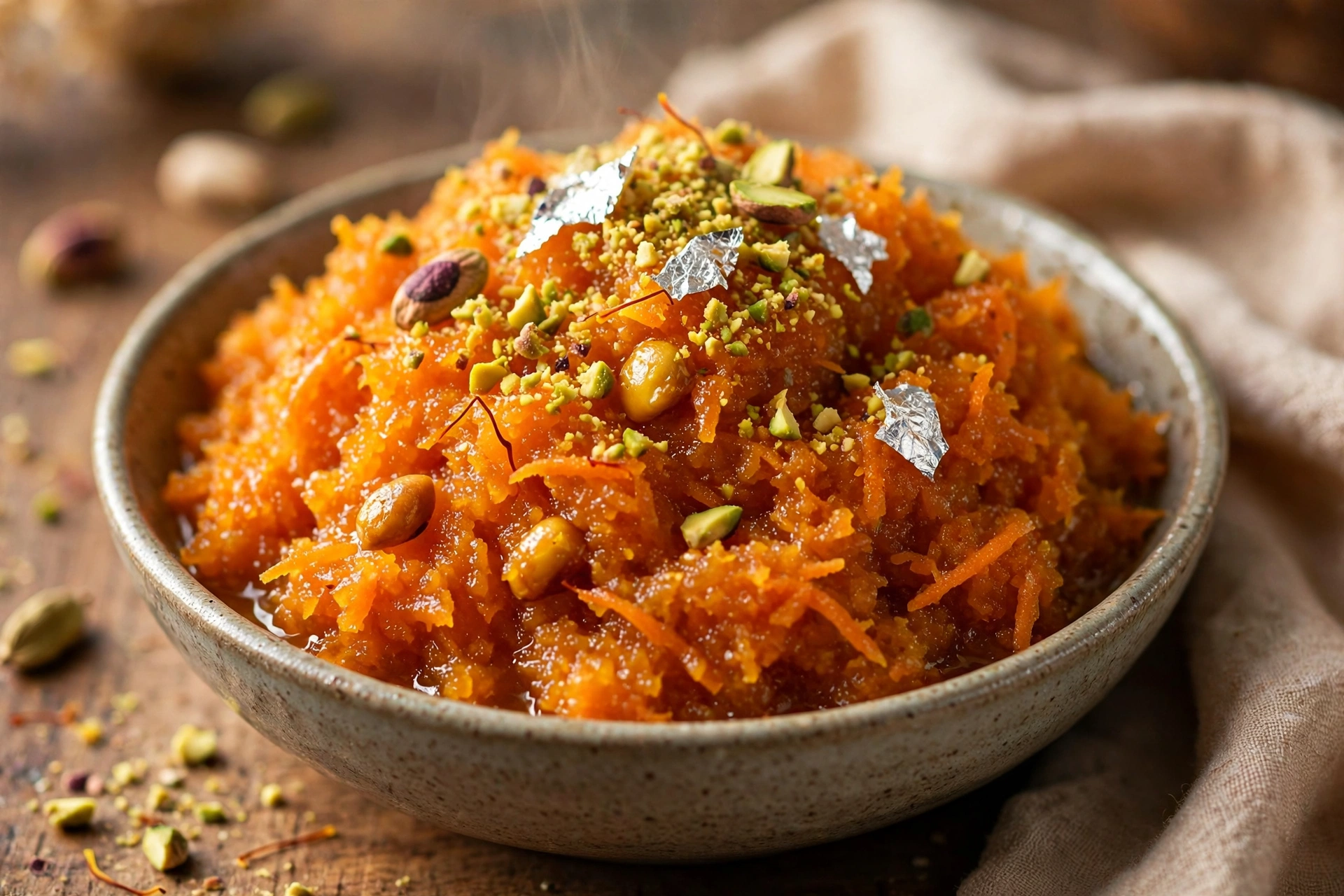
Every winter in my childhood home, the arrival of red winter carrots meant one thing: gajar ka halwa season had begun. The whole house would smell of carrots slow-cooking in milk, ghee, and cardamom for hours. This gajar ka halwa recipe is my family’s version — rich, jewel-red, studded with nuts — and while it takes some patience, I promise the result is worth every minute of stirring.
If you have only ever had halwa from a sweet shop, homemade is a revelation. You control the sweetness, the ghee, the texture. My mother always insisted on grating the carrots by hand rather than using a food processor — she claimed the texture was better, and after testing both ways more times than I can count, I’ve grudgingly admitted she was right. Hand-grated carrots give you those lovely distinct shreds that make great halwa.
What surprises most first-time makers of this gajar ka halwa recipe is how the flavor deepens as it cooks. The raw grated carrot tastes nothing like the finished halwa — the long, slow simmer with milk caramelizes the natural sugars and concentrates everything into something almost fudge-like. My grandmother used to make it in a massive lagan for weddings, stirring with a wooden spoon as long as my arm, and the whole neighborhood would know halwa was on the way.
Why You’ll Love This Gajar Ka Halwa Recipe
- Classic winter dessert — the definitive way to use seasonal red carrots.
- Just a few ingredients — carrots, milk, sugar, ghee, cardamom, nuts.
- Make-ahead friendly — keeps for a week in the fridge and reheats perfectly.
- Crowd-pleaser — serve warm with a scoop of vanilla ice cream and watch it disappear.
- Customizable sweetness — adjust sugar to your taste; the carrots bring natural sweetness too.
Ingredients
- 1 kg (about 8-9 medium) red winter carrots, peeled and grated
- 1 liter (4 and 1/4 cups) full-cream milk
- 3/4 to 1 cup (150-200 g) sugar, to taste
- 4 tablespoons ghee (60 g), divided
- 1/2 teaspoon cardamom powder
- 1/4 cup (40 g) chopped almonds
- 1/4 cup (40 g) chopped pistachios
- 2 tablespoons raisins (optional)
- A pinch of salt
Instructions
- Cook carrots in milk. Put the grated carrots and milk in a wide, heavy-bottomed pan or kadai over medium heat. Bring to a boil, then reduce to a steady simmer. Cook uncovered, stirring every few minutes, for 35 to 45 minutes, until the milk has reduced and thickened and the carrots are completely soft. A wide pan is important here — more surface area means faster evaporation. This slow reduction is the heart of any good gajar ka halwa recipe; rushing it with high heat scorches the milk.
- Add sugar. Stir in the sugar and the pinch of salt. The mixture will loosen immediately as the sugar melts — this is normal. Keep cooking, stirring more frequently now, for another 12 to 15 minutes until the liquid is mostly absorbed and the halwa starts to look glossy.
- Add ghee and finish. Add 3 tablespoons of the ghee and the cardamom powder. Cook, stirring constantly now, for 8 to 10 minutes. You’ll know it’s done when the halwa pulls away from the sides of the pan, the ghee glistens at the edges, and a spoon dragged through leaves a clean trail. Stir in the raisins if using.
- Toast the nuts. In a small pan, heat the remaining tablespoon of ghee and lightly toast the almonds and pistachios for a minute until fragrant. Pour over the halwa and mix half through, reserving some for the top.
- Serve warm. Serve the halwa warm, garnished with the reserved nuts. It’s wonderful on its own, and downright luxurious with a scoop of vanilla ice cream melting over it.
Pro Tips
- Use red winter carrots. The long red carrots available in winter are sweeter and give halwa its signature deep color. Orange carrots work but the flavor and color won’t be quite the same.
- Hand-grate for best texture. A food processor shreds carrots too fine and releases too much juice. The medium holes of a box grater give you perfect shreds.
- Full-cream milk only. Low-fat milk takes forever to reduce and the halwa lacks richness. If you’re short on time, replace half the milk with a 200 ml tin of evaporated milk.
- Don’t add sugar too early. Sugar goes in only after the milk has reduced. Added early, it prevents the carrots from softening properly and the halwa turns out chewy.
- Watch the final stage. The last 10 minutes need constant stirring — the sugars can catch and burn quickly once most of the liquid is gone.
- Khoya shortcut. For an even richer halwa, crumble in 200 g of khoya (mawa) with the sugar. It’s not traditional in every household, but it is delicious.
FAQs
Can I make gajar ka halwa with condensed milk?
Yes — replace the sugar with about 3/4 tin (300 g) of sweetened condensed milk, added after the milk has reduced. Reduce the added sugar since condensed milk is already sweet. It speeds things up and adds richness.
Why is my halwa pale instead of deep red?
Usually it’s the carrots — orange carrots give an orange halwa. Red winter carrots are the key to that jewel-red color. Also make sure you’re cooking long enough for the milk solids to caramelize slightly, which deepens the color.
How long does gajar ka halwa keep?
Refrigerated in an airtight container, it keeps for 7 to 10 days. Reheat gently with a splash of milk to restore the creamy texture. It also freezes well for up to 2 months.
Can I reduce the ghee and sugar?
You can trim both to taste — start with half the ghee and 1/2 cup sugar and adjust. The halwa will be lighter but still good. Just don’t eliminate the ghee entirely; it’s essential to the flavor and the glossy finish.
That’s my family’s gajar ka halwa recipe — slow, simple, and deeply comforting. Make it on a cold evening when you have nowhere to be, let the smell fill the house, and serve it warm. Some desserts are just food; this one is a memory.