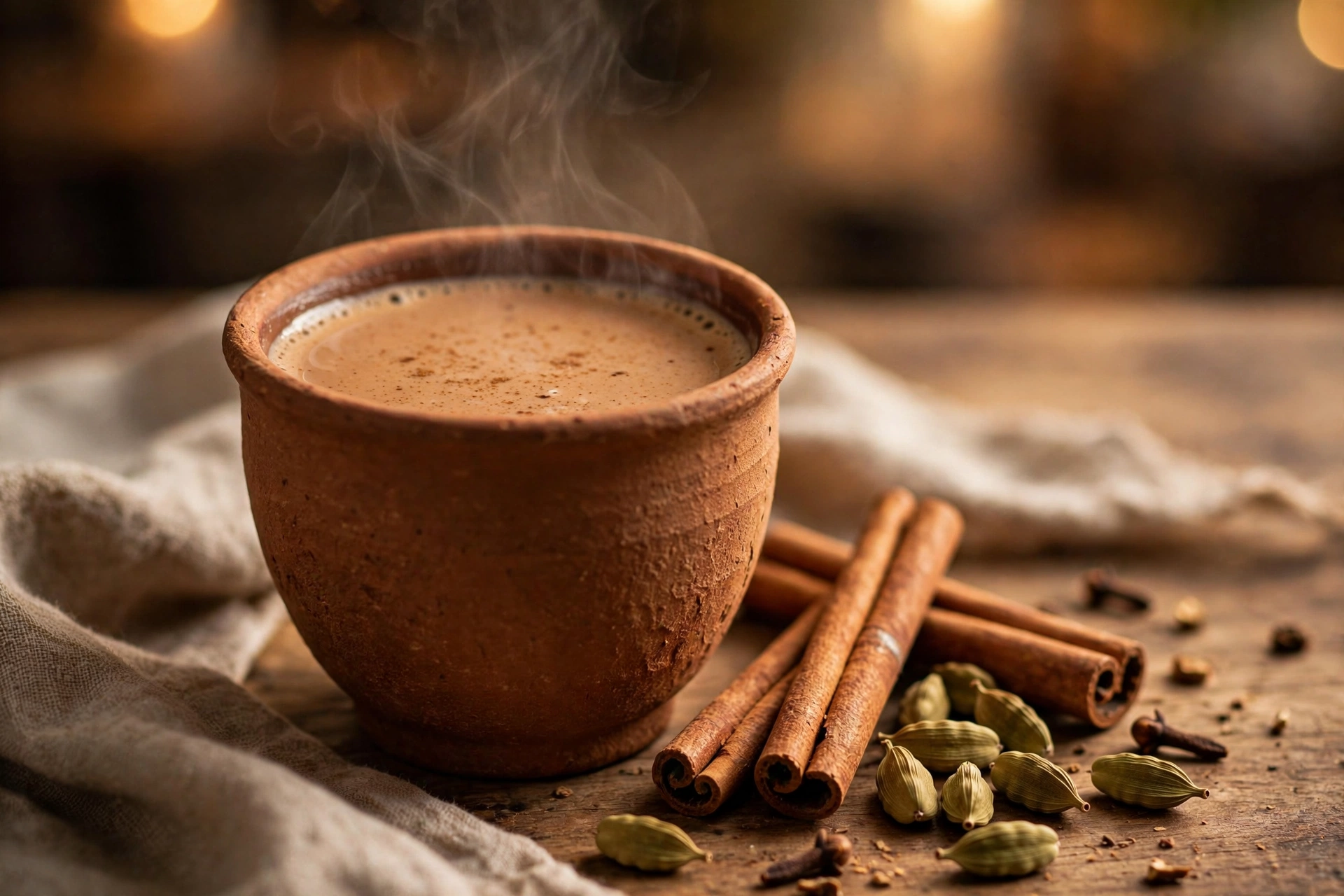
There’s chai, and then there’s dhaba-style masala chai — the kind that’s boiled hard with crushed spices until it’s strong enough to stand a spoon in, sweetened generously, and poured from a height so it develops that frothy top. This masala chai recipe makes the real thing: Assam tea leaves simmered with fresh ginger, cardamom, cloves, and cinnamon, finished with full-cream milk. It’s nothing like a tea bag dunked in hot water, and once you’ve had it properly made, the pale imitations will ruin themselves for you.
I drank my first proper dhaba chai on a road trip, at a stall where the owner boiled the same pot all day, topping it up with milk and tea as it sold. He crushed the ginger with the flat of a knife, threw in spices by feel, and boiled everything so vigorously the pot nearly danced on the burner. It was strong, sweet, milky, and spiced in a way that warmed you from the inside — nothing like the polite, weak chai I’d been making at home with a tea bag and a cinnamon stick waved vaguely in its direction.
The difference between mediocre masala chai and great masala chai comes down to three things: strong tea (loose CTC leaves, not bags), real boiling (not steeping), and fresh spices crushed just before brewing. The boiling is what extracts the tea’s full body and melds the spices into the milk — a gentle steep gives you flavored water, but a rolling boil gives you chai. This recipe follows the dhaba method, scaled for a home kitchen.
Why You’ll Love This Masala Chai Recipe
- Dhaba-strong flavor — properly boiled with loose CTC tea for real body and depth.
- Fresh crushed spices — ginger, cardamom, cloves, and cinnamon, ground just before brewing.
- Ready in 15 minutes — faster than driving to the chai stall, and you don’t have to share.
- Customizable sweetness and strength — make it exactly how you like it, from kadak to mild.
- The perfect monsoon companion — hot, spiced, milky chai with pakoras on a rainy evening is close to perfect happiness.
Ingredients
- Water — 2 cups (480 ml)
- Full-cream milk — 1.5 cups (360 ml); whole milk gives the richest result
- Loose CTC Assam tea leaves — 3 tablespoons (about 15 g); or 4 strong tea bags as backup
- Fresh ginger — 1-inch piece, peeled and crushed
- Green cardamom pods — 4, crushed
- Whole cloves — 4
- Cinnamon stick — 1-inch piece, broken
- Black peppercorns — 4 to 5 (optional, for warmth)
- Sugar — 3 to 4 tablespoons, or to taste; dhaba chai is sweet
Instructions
- Crush the spices fresh. Using a mortar and pestle (or the flat of a heavy knife on a cutting board), crush the cardamom pods, cloves, cinnamon, and peppercorns into a coarse powder — not fine dust, just broken enough to release their oils. Crush the ginger separately into a rough pulp. Fresh-crushing right before brewing makes an enormous difference; pre-ground spices lose their volatile oils within weeks, and stale spices are the reason many homemade chais taste flat. You should be able to smell the cardamom from across the kitchen the moment you crush it.
- Boil water with spices. Bring the 2 cups of water to a rolling boil in a saucepan, then add all the crushed spices and the ginger. Let it boil hard for 2 to 3 minutes. This spice-first boil blooms the flavors into the water before the tea goes in — it’s the step most home recipes skip, and it’s why dhaba chai tastes layered rather than just spicy on top. The water will turn fragrant and slightly golden.
- Add the tea and boil again. Add the CTC tea leaves and let everything boil vigorously for 2 minutes. CTC (crush-tear-curl) leaves are small granules that release their flavor fast and strong — they’re what every dhaba and most Indian homes use, and they’re the reason the chai gets that deep amber color and robust body. Don’t be gentle here; the hard boil is what extracts the tea fully. You’ll see the liquid turn a rich reddish-brown.
- Add milk and bring to a boil. Pour in the milk and add the sugar. Now bring the whole thing back to a full, rolling boil — and here’s the dhaba trick: let it rise up in the pan, pull it off the heat for a few seconds as it settles, then put it back on and let it rise again. Do this two or three times. Each rise-and-fall cycle aerates the chai, deepens the flavor, and builds that light froth on top. Watch it like a hawk during this stage; boiled-over chai on a stovetop is a mess nobody wants to clean.
- Strain and serve immediately. Turn off the heat and strain the chai through a fine-mesh strainer directly into cups or a warmed teapot — pressing the leaves gently with the back of a spoon to extract the last drops. For the full dhaba effect, pour it from a height of about six inches into each cup; the aeration creates a beautiful froth. Serve piping hot, immediately. Masala chai waits for no one — it loses its magic as it cools, so gather everyone before you strain.
Pro Tips
- CTC leaves, not tea bags. This is the single biggest upgrade. Loose CTC Assam gives body and color that bags can’t match. Find it at any South Asian grocery store.
- Boil, don’t steep. Gentle steeping makes flavored water; hard boiling makes chai. The vigorous boil extracts tea and melds spices in a way steeping never will.
- Crush spices fresh every time. It takes 60 seconds and transforms the cup. Pre-ground masala blends are convenient but noticeably duller.
- Full-cream milk matters. Skim or low-fat milk makes thin, sad chai. The fat carries the spice flavors and gives the luxurious mouthfeel.
- Control the kadak factor. For stronger chai, boil the tea a minute longer before adding milk. For milder, add milk earlier. Make it yours.
- Sweeten while boiling. Sugar dissolved during the boil integrates completely; sugar stirred in at the end sits on top of the flavor instead of in it.
Serving Suggestions
Masala chai is a complete experience on its own, but it truly shines with the right company. The classic pairing is pakoras or samosas on a rainy evening — crispy, salty snacks against hot, sweet, spiced chai is one of life’s great combinations. It’s also wonderful with rusk or butter biscuits for dunking at breakfast, or with a slice of tea cake in the afternoon. For guests, serve it in small glasses or kulhads (clay cups) if you can find them — they keep it hot and add an earthy note that regular cups don’t.
FAQs
Can I make masala chai with tea bags?
You can in a pinch — use 4 strong black tea bags (Assam or English Breakfast) instead of the loose leaves. But be honest with yourself: it will be good, not great. Loose CTC leaves release far more flavor and body. If you drink chai regularly, buying a bag of CTC leaves is the best small investment you can make.
Why is my chai bitter?
Usually over-boiled tea. Two minutes of hard boiling after adding the leaves is the sweet spot; much longer and the tannins turn harsh. Also, make sure you’re not re-boiling already-brewed chai — always start fresh. Adding the milk and sugar on time mellows everything out.
Can I make masala chai without milk?
Yes — that’s essentially spiced black tea, sometimes called suleimani in some regions. Follow the recipe through step 3, skip the milk, sweeten to taste, and strain. It’s lighter and lets the spices shine differently. Add a squeeze of lemon for a refreshing twist.
How do I store leftover masala chai?
Honestly, it’s best fresh — reheated chai is never quite the same. But if you must, refrigerate for up to a day and reheat gently on the stove (never microwave, which scalds the milk). Better plan: halve the recipe. It scales perfectly.
Is masala chai very caffeinated?
A cup has roughly half to two-thirds the caffeine of regular coffee, depending on how strong you brew it. The milk and the relatively small serving size (dhaba glasses are small) keep it moderate. If you’re sensitive, brew it milder or enjoy it before evening.
That’s the dhaba method: crush fresh, boil hard, aerate with the rise-and-fall, and serve immediately. Once you make masala chai this way, the tea-bag version will taste like a rumor of chai. Keep the CTC leaves stocked, and rainy evenings will never be the same.