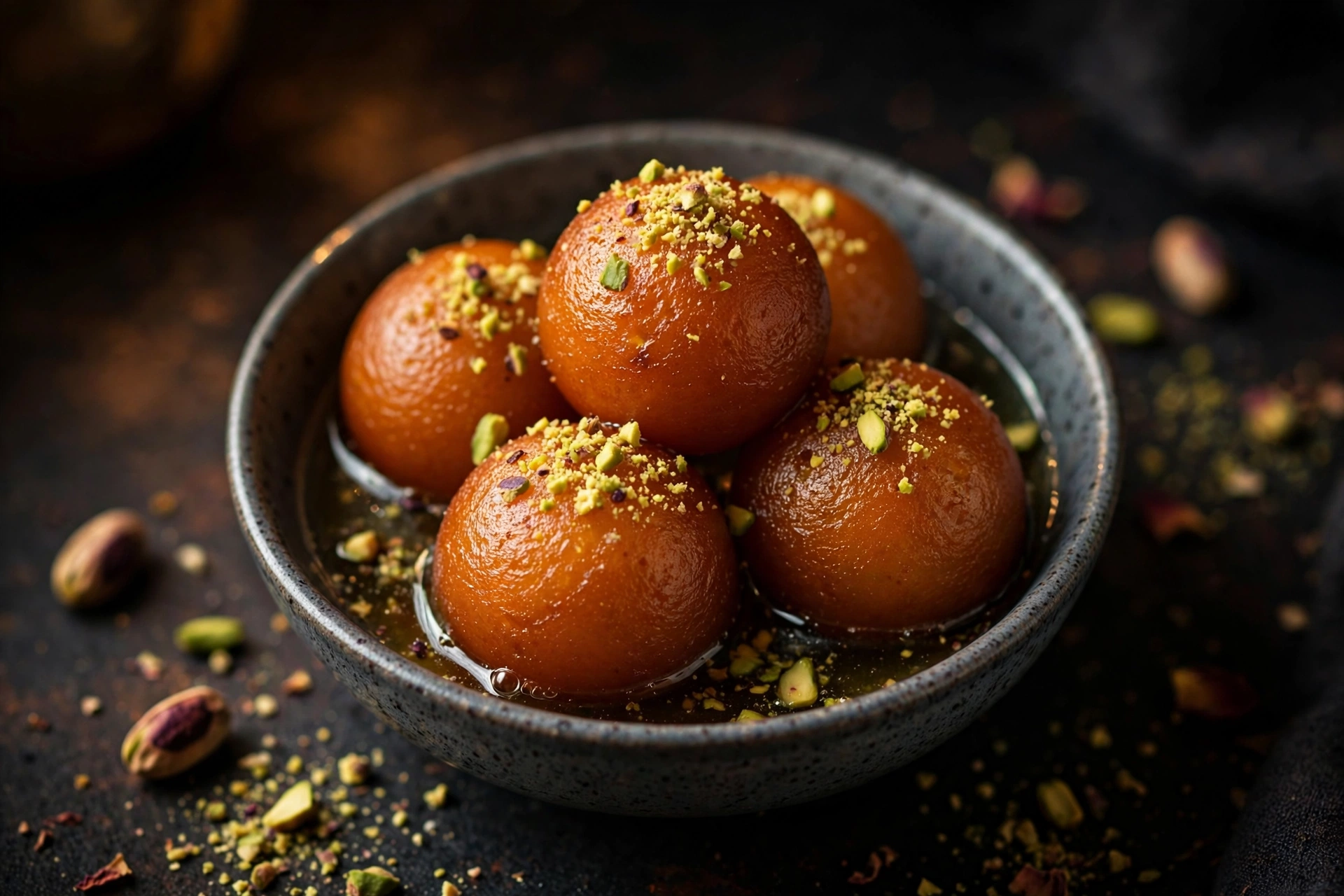
There is no sadder dessert than a hard gulab jamun. You bite in expecting that burst of warm syrup and instead get something closer to a golf ball. I have served my share of disappointing jamuns over the years — dense ones, cracked ones, ones that stayed pale and raw in the middle — until I finally figured out that this gulab jamun recipe fails or succeeds on three things: the softness of the dough, the temperature of the oil, and the temperature of the syrup. Get those three right and you get jamuns so soft and juicy they practically melt.
This is a milk-powder gulab jamun recipe, which is how most home cooks make them now. The dough comes together in ten minutes, the frying needs patience rather than skill, and the result is golden, syrup-soaked jamuns that vanish before they cool.
Here is my tested gulab jamun recipe, with every mistake I have already made so you do not have to.
Why You Will Love This Gulab Jamun Recipe
- Soft, spongy jamuns that soak up syrup all the way to the center
- Made with easy-to-find milk powder — no hard-to-source khoya needed
- Clear frying-temperature guidance so they never burn outside and stay raw inside
- The syrup stays thin and soakable, never thick and candy-like
- Perfect make-ahead dessert for Eid, Diwali, and dawats
Ingredients
For the jamuns (makes about 20):
- 1 cup (125 g) full-cream milk powder
- 1/4 cup (30 g) all-purpose flour (maida)
- 1/4 teaspoon baking soda (not baking powder — measure carefully)
- 1 tablespoon ghee, plus more for greasing hands
- 1/4 cup (60 ml) warm milk, plus 1 to 2 tablespoons extra if needed
- 1 tablespoon yogurt (optional, makes them extra soft)
- Oil or ghee, for deep frying (ghee gives the best flavor)
For the syrup:
- 1.5 cups (300 g) sugar
- 1.5 cups (360 ml) water
- 4 green cardamoms, lightly crushed
- 1 teaspoon rose water (or 1/2 teaspoon kewra water)
- 1 teaspoon lemon juice (stops the syrup from crystallizing)
- A few saffron strands — optional
For garnish:
- 2 tablespoons pistachios, slivered
- 1 teaspoon dried rose petals — optional
Instructions
- Make the syrup first and keep it warm. Combine the sugar, water, and crushed cardamoms in a wide pan and bring to a boil, stirring until dissolved. Add the lemon juice and simmer 5 to 6 minutes until thin and lightly sticky — it should coat a spoon but pour easily. Stir in the rose water and saffron, then keep on the lowest heat. This matters: jamuns go into warm syrup, not boiling and not cold. Cold syrup will not absorb; boiling syrup can break them.
- Mix a soft, crack-free dough. In a bowl, whisk together the milk powder, flour, and baking soda, breaking up every single lump — I run the mixture through a sieve because even tiny lumps of milk powder become hard spots in the finished jamun. Rub in the tablespoon of ghee with your fingertips until the mixture resembles breadcrumbs. Add the yogurt if using, then add the warm milk a tablespoon at a time, gathering the mixture into a dough. It should be soft, smooth, and pliable like soft playdough — not sticky, not crumbly. Cover with a damp cloth and rest for 15 minutes. This rest hydrates the milk powder fully and is the difference between smooth jamuns and cracked ones.
- Roll perfectly smooth balls. Grease your palms lightly with ghee. Pinch off small portions of dough — about the size of a walnut, since they nearly double when fried — and roll each between your palms with gentle, even pressure until completely smooth with no cracks or seams. This is the fussiest part of the whole gulab jamun recipe, so do not rush it. Any crack on the surface will split open in the hot oil and let oil seep inside. If the dough feels dry while rolling, dampen your palms very slightly rather than adding water to the dough.
- Fry low and slow — patience is the whole game. Heat the oil or ghee in a deep, heavy kadhai over low-medium heat. The oil must be at about 120 to 130°C (250°F) — much cooler than you would expect. Test with a tiny piece of dough: it should sink to the bottom, then rise slowly to the surface over 30 to 40 seconds with gentle bubbling. If it browns immediately, your oil is too hot — take the pan off the heat for two minutes. Slide in the jamuns a few at a time without crowding, and stir the oil gently in a circular motion so they roll around and brown evenly on all sides. This slow fry takes 8 to 10 minutes per batch. They will first swell, then turn the palest gold, then deepen to a rich golden brown. Do not be tempted to crank the heat to speed things up — high heat gives you jamuns that are dark outside and doughy inside, the classic failure.
- Soak in warm syrup. Lift the fried jamuns out with a slotted spoon, let the excess oil drip off for a few seconds, and transfer them directly into the warm syrup. They should sizzle very gently on contact. Let them soak for at least 2 hours at room temperature — during this time they will swell further and drink up the syrup until the centers are juicy. I usually make them in the afternoon for an evening dawat. Before serving, warm the whole pan gently for 5 minutes so they are served warm, which is how gulab jamun tastes best. Garnish with slivered pistachios and rose petals.
Pro Tips
- Measure the baking soda carefully — even slightly too much gives a soapy taste and makes jamuns disintegrate in oil. Level off that quarter teaspoon.
- If your jamuns crack while rolling, the dough is too dry. Work in half a teaspoon of warm milk at a time until it rolls smooth. Do not add flour to fix stickiness; use ghee on your palms instead.
- Fry in ghee if you can afford it, or at least do half ghee and half neutral oil. The flavor difference is real — ghee-fried jamuns have a richness that oil alone cannot match.
- Never fry a full test batch to check the oil. Fry exactly one jamun first: if it holds together, browns slowly, and does not crack, your dough and temperature are both right. Adjust before committing the rest.
- Syrup too thick is the second most common failure. It should be thin enough that a cut-open jamun shows syrup all the way through — not a dry white center in a sweet shell.
- Jamuns keep beautifully. Refrigerate soaked jamuns in their syrup for up to a week. Warm gently before serving; microwaving a single portion for 20 seconds works fine.
FAQs
Why did my gulab jamuns turn hard?
The usual culprits: dough mixed too stiff, oil too hot (outside sets before inside cooks), or over-kneading, which develops gluten. Soft dough and low, slow frying fix nearly every case.
Can I make this gulab jamun recipe with khoya instead of milk powder?
Yes. Replace the milk powder with 1 cup (200 g) of soft, fresh khoya (mawa), reduce the ghee to 1 teaspoon, and skip the yogurt. Khoya-based jamuns have a slightly richer, more traditional taste, but the dough is trickier — it must be kneaded until completely smooth with no graininess. Milk powder is more forgiving for beginners.
Why are my jamuns breaking apart in the oil?
Either too much baking soda, dough that was not rested, or the jamuns went into the oil before it was hot enough and sat there absorbing oil instead of searing. The single-jamun test fry described in the instructions catches all of these problems before you risk the batch.
Can I make gulab jamun ahead for a party?
They are ideal for making ahead — they need those 2 hours of soaking anyway. Make them the morning of your event, keep in syrup at room temperature for a day (refrigerate longer), and warm gently before serving.
That is my complete gulab jamun recipe — soft, juicy, and golden every single time once you respect the low flame and the warm syrup. Make a batch this weekend, and watch them vanish while they are still warm.