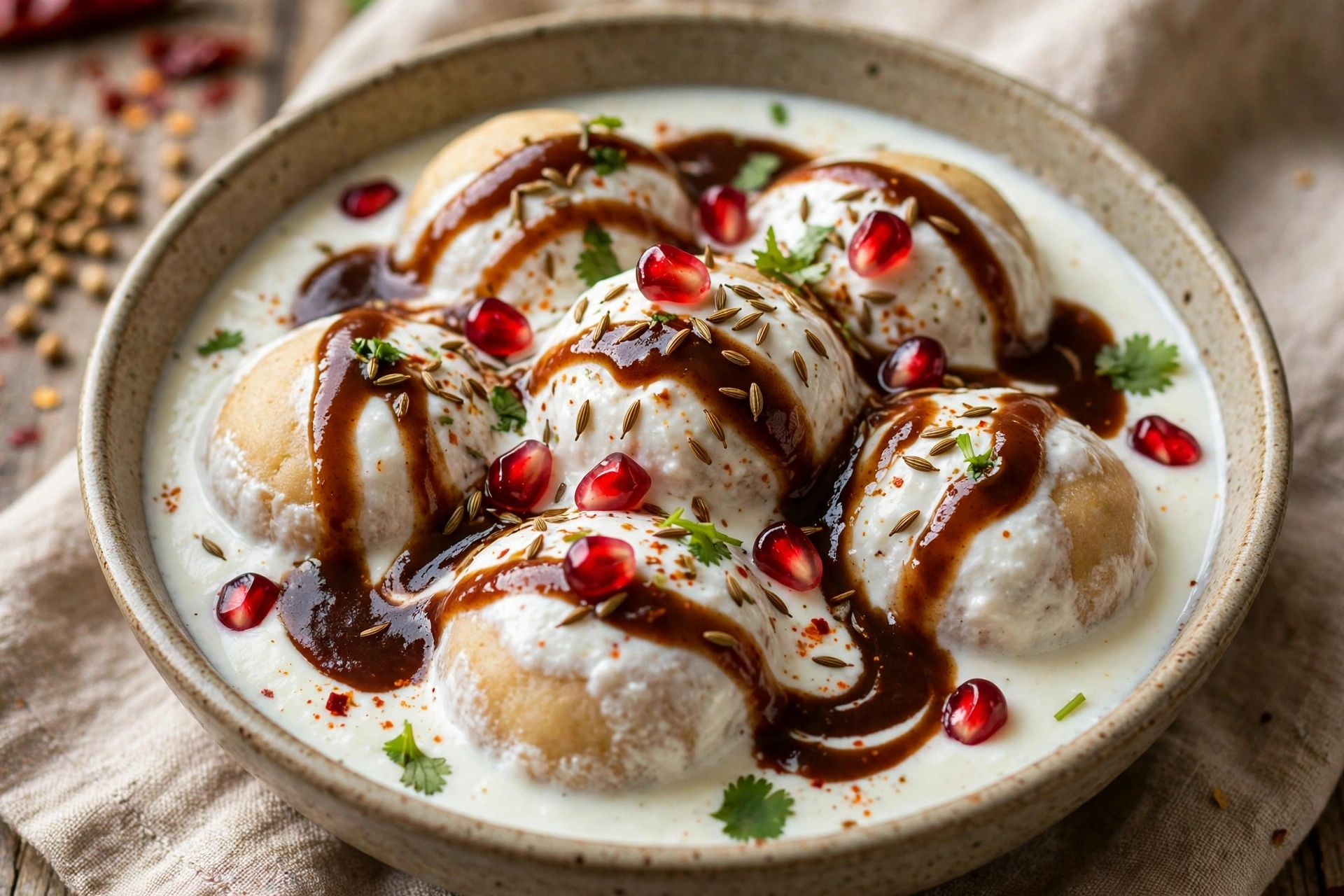
Every Ramadan in our house, the iftar table wasn’t complete without a big bowl of dahi bhalla glistening under a blanket of yogurt. My grandmother would start soaking the dal in the morning, and by evening the whole kitchen smelled of frying bhallas. This dahi bhalla recipe is hers, more or less — I’ve only adjusted the grinding technique, because she had a stone grinder and infinite patience, and I have a mixer and a deadline.
Dahi bhalla (also called dahi vada in some regions) is one of the great chaats: soft, spongy lentil dumplings soaked until pillowy, tucked into seasoned yogurt, and finished with the classic chaat trinity of tamarind chutney, roasted cumin, and red chili powder. Eaten cold, it’s the perfect counterpoint to a plate of hot samosas — cool, tangy, sweet, and savory all at once.
The heartbreak of dahi bhalla is a dense, hard center. I suffered through several batches of what my brother called “lentil golf balls” before I understood the two things that matter: the batter must be whipped until fluffy and aerated, and the fried bhallas must soak in warm water long enough to go completely soft inside. Get those right and the bhallas turn into little sponges that melt in your mouth.
This recipe makes about 20 bhallas (serves 6 to 8 as a snack) and most of the work can be done ahead — the bhallas actually improve after a few hours in the fridge. Let’s make chaat.
Why You’ll Love This Dahi Bhalla Recipe
- Melt-in-mouth texture — the whipped-batter plus warm-water soak method guarantees soft centers, never dense.
- Perfect make-ahead chaat — assemble hours before serving; it’s meant to be eaten cold.
- Balanced flavors — tangy yogurt, sweet tamarind, earthy cumin, and a kick of chili in every bite.
- Customizable toppings — from classic to loaded, everyone can dress their own plate.
- High-protein snack — urad dal dumplings with yogurt make this surprisingly substantial.
- Freezer friendly — freeze the fried bhallas and assemble fresh chaat anytime.
Ingredients
- For the bhallas:
- Urad dal (split black gram, skinless) — 1 cup (200 g)
- Moong dal (split yellow) — ¼ cup (50 g), optional but makes lighter bhallas
- Ginger — 1-inch piece, grated
- Green chili — 1, finely minced (optional)
- Cumin seeds — 1 teaspoon
- Baking soda — ¼ teaspoon (helps the puff)
- Salt — ¾ teaspoon
- Water — for soaking dal and as needed for grinding (about 3 to 4 tablespoons)
- Oil — for deep frying (about 3 cups / 750 ml)
- For soaking:
- Warm water — 6 cups, with 1 teaspoon salt and a pinch of hing (asafoetida, optional)
- For the yogurt:
- Plain yogurt — 3 cups (720 g), thick and fresh (not sour)
- Powdered sugar — 2 to 3 tablespoons (balances the tang)
- Salt — ½ teaspoon
- Roasted cumin powder — 1 teaspoon, plus more for garnish
- For topping:
- Tamarind chutney — ½ cup (sweet-sour imli chutney)
- Red chili powder — for dusting
- Chaat masala — 1 teaspoon
- Fresh coriander — ¼ cup, chopped
- Pomegranate seeds — ¼ cup (optional, for jewel-like color)
- Sev (crispy chickpea noodles) — ¼ cup (optional crunch)
Instructions
- Soak the dals. Rinse the urad dal and moong dal together under running water until the water runs clear, then soak in plenty of fresh water for 5 to 6 hours, or overnight in the fridge. Proper soaking is non-negotiable — under-soaked dal grinds gritty and makes heavy bhallas. The dal is ready when a grain crushes easily between your fingernails.
- Grind to a fluffy batter. Drain the dals completely — excess water is the enemy of a thick batter. Grind in a mixer grinder with just 3 to 4 tablespoons of water, stopping to scrape down the sides, until you have a thick, smooth, almost dough-like batter. It should be much thicker than dosa or pancake batter; if it’s pourable, it’s too thin. Now the crucial part: whip the batter vigorously with your hand or a whisk for 4 to 5 minutes until it turns pale, fluffy, and aerated. Test it the traditional way — drop a tiny blob in a bowl of water; if it floats, your batter is ready. Fold in the ginger, green chili, cumin seeds, baking soda, and salt at the very end.
- Fry the bhallas. Heat oil in a kadhai over medium heat to about 170°C (340°F) — slightly cooler than for pakoras, so the bhallas cook through without browning too fast. Wet your hands (this prevents sticking), scoop a lemon-sized portion of batter, shape it roughly round with your thumb making a slight dent, and gently slide it into the oil. Fry 5 to 6 at a time without crowding, turning occasionally, for 5 to 6 minutes until deep golden all over. They’ll puff up nicely. Drain on a wire rack.
- Soak in warm salted water. While the bhallas are still warm, slip them into the bowl of warm salted water (with the pinch of hing if using). Let them soak for 20 to 25 minutes. You’ll see them swell and soften — this step is what transforms a fried dumpling into a spongy dahi bhalla. After soaking, lift each bhalla out and press very gently between your palms to squeeze out the excess water. Be gentle; they’re delicate now. This squeezing is important — waterlogged bhallas dilute the yogurt.
- Prepare the seasoned yogurt. Whisk the yogurt until completely smooth — no lumps. Whisk in the powdered sugar, salt, and roasted cumin powder. Taste it: it should be pleasantly tangy-sweet with a warm cumin background, like a good chaat yogurt. If your yogurt is very sour, add a little more sugar; if it’s bland, a squeeze of lemon helps. Keep chilled until assembling.
- Assemble the chaat. Arrange the squeezed bhallas in a wide serving dish in a single layer. Pour the seasoned yogurt generously over them, making sure each bhalla is well covered and yogurt pools around them. Drizzle the tamarind chutney in zigzags over the top. Dust with red chili powder, chaat masala, and extra roasted cumin powder. Scatter over the coriander, pomegranate seeds, and sev if using. The layering of colors — white yogurt, brown tamarind, red chili, green coriander — is part of the joy.
- Chill and serve cold. Cover and refrigerate for at least 1 hour so the bhallas absorb the yogurt and everything melds. Dahi bhalla must be served cold — room temperature dulls all the bright flavors. Serve in individual bowls with extra chutneys on the side so everyone can adjust sweetness and heat.
Pro Tips
- The float test never lies. If your batter blob sinks in water, whip for 2 more minutes and test again. Aeration is the difference between spongy and stony.
- Grind thick, always. You can never remove water from a thin batter, but you can always whip a thick one. Add water by the teaspoon when grinding.
- Fry at moderate heat. Too hot and the outside browns while the inside stays raw and dense; too cool and they drink oil. Medium heat, golden in 5 to 6 minutes, is the zone.
- Soak while warm. Bhallas absorb the salted water best when they go in warm from the fryer. Cold bhallas soak slowly and unevenly.
- Squeeze gently but thoroughly. Press out the soaking water or your yogurt turns watery. Cup the bhalla in your palm and press — don’t wring it like a cloth.
- Use fresh, not sour, yogurt. Sour yogurt makes the whole dish harsh. If your yogurt is tart, the powdered sugar helps, but starting with mild yogurt is better.
- Assemble ahead, garnish late. The bhallas can sit in yogurt for hours (even overnight), but add sev and pomegranate just before serving so they stay crisp and bright.
Serving Suggestions
Dahi bhalla shines as part of a chaat spread — serve it alongside samosas, aloo tikki, and bhel puri with a lineup of chutneys (tamarind, mint-coriander, and garlic) so guests can mix and match. For iftar, it’s the cool, soothing counterpoint to fried snacks. As a standalone snack, a bowl of dahi bhalla with extra pomegranate and sev is deeply satisfying on a hot afternoon. Keep everything chilled until the moment of serving.
FAQs
Why are my bhallas hard inside?
Almost always under-whipped batter or too-thin batter. The batter must be thick and whipped until a test blob floats in water. Also check your soak — 20 full minutes in warm salted water is the minimum for the centers to soften.
Can I make dahi bhalla without moong dal?
Yes — use 1¼ cups of urad dal alone. Moong dal just makes the texture a touch lighter and is traditional in some families. All-urad bhallas are the classic version and completely authentic.
Can I bake or air-fry the bhallas instead?
You can, but the texture changes — baked bhallas are denser and don’t soak up water as readily. If you must, brush with oil and bake at 200°C (400°F) for 18 to 20 minutes, then soak a full 30 minutes. It works, but deep-fried is traditional for a reason.
How long does assembled dahi bhalla keep?
Up to 2 days refrigerated in an airtight container — the flavors actually improve on day two. Add fresh garnishes (sev, pomegranate, coriander) just before serving. The fried, unsoaked bhallas freeze well for a month; thaw, soak, and assemble fresh.
And that’s my grandmother’s dahi bhalla — pillowy lentil dumplings in cool spiced yogurt with all the chaat fixings. Make a big batch; it never survives long in my house, and I doubt it will in yours either.