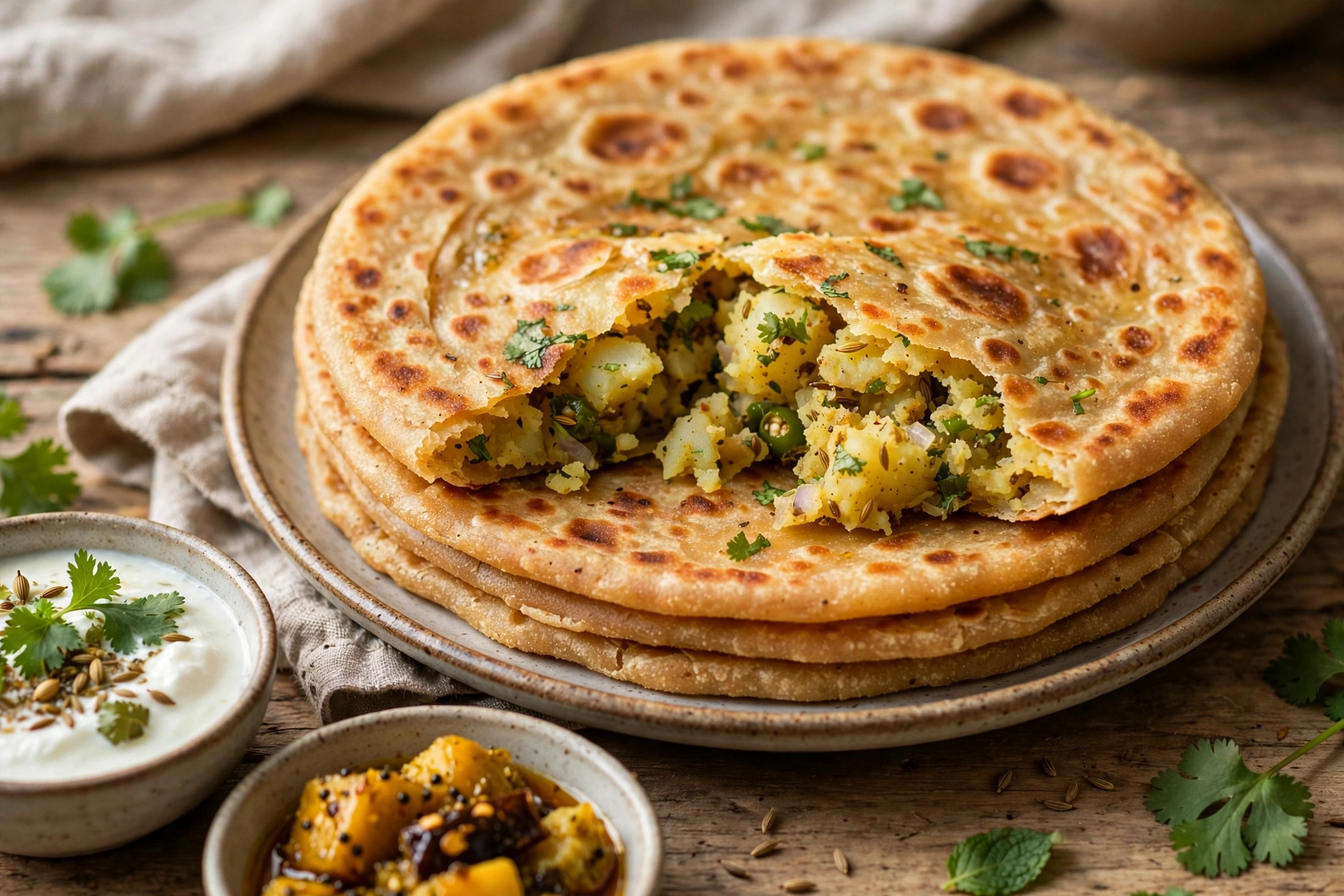
If there is one breakfast my kids request more than any other, it is aloo paratha — golden, flaky flatbreads stuffed with spiced mashed potatoes, served with a dollop of white butter melting on top. This aloo paratha recipe is the one I grew up eating at my grandmother’s house in Lahore, where the parathas arrived at the table puffed up like little balloons and disappeared within minutes. I have made these hundreds of times since, and I have finally nailed down every detail that separates a good paratha from a great one.
The tragedy of most homemade aloo parathas is the filling bursting through the dough while you roll, leaving you with a torn, lopsided mess and potato stuck to your rolling pin. That happens for exactly two reasons: the filling is too wet, or the dough is too soft. Fix those two things — dry, well-seasoned filling and a firm, rested dough — and your parathas will roll out smooth and cook up beautifully puffed, every single time.
Fair warning: your first two or three parathas might look a bit rustic. Mine certainly did. But by the fourth one you will have the rhythm down, and nobody at the breakfast table is grading you on perfect circles anyway.
Why You’ll Love This Recipe
- No tearing, no bursting — the dry-filling method in this recipe means the potato stays inside where it belongs.
- Pantry ingredients only — potatoes, flour, and spices you already have. No special shopping trip.
- Freezer-friendly — stack cooked parathas with baking paper between them and freeze for up to 2 months.
- Kid-approved — mild, comforting, and endlessly dippable in yogurt or pickle.
- Complete meal — with raita and a cup of chai, this is breakfast, lunch, or a light dinner sorted.
Ingredients
- For the dough: 3 cups (375g) whole wheat flour (atta), plus extra for dusting
- 1 teaspoon salt
- 1 tablespoon oil or melted ghee
- 1¼ cups (300ml) warm water, approximately
- For the potato filling: 4 medium potatoes (about 600g), boiled, peeled and completely cooled
- 1 small onion, very finely chopped (optional but lovely)
- 2 green chillies, finely minced
- 2 tablespoons fresh coriander leaves, chopped
- 1 teaspoon cumin seeds, lightly crushed
- 1 teaspoon coriander powder
- ½ teaspoon garam masala
- ½ teaspoon amchur (dried mango powder) — or 1 teaspoon lemon juice
- ¾ teaspoon salt, plus more to taste
- For cooking: ghee or oil, about 3–4 tablespoons total
Instructions
- Make the dough first. Mix the flour and salt in a large bowl, then rub in the oil with your fingertips until the mixture looks like coarse breadcrumbs. Add warm water a little at a time, mixing as you go, until a firm (not soft, not sticky) dough comes together. Knead for 6–8 minutes until smooth and elastic. This dough should feel firmer than roti dough — that firmness is what keeps the filling from bursting through later. Cover with a damp cloth and rest for at least 30 minutes; rested dough rolls without springing back.
- Prepare a dry filling. Mash the cooled boiled potatoes until completely smooth — no lumps, because lumps poke through the dough. This is critical: the potatoes must be stone cold and dry. Warm potatoes release steam and turn the filling soggy. I boil mine the night before and refrigerate them; cold potatoes mash drier and firmer. Mix in the onion, green chillies, coriander, cumin seeds, coriander powder, garam masala, amchur and salt. Taste it — the filling should be boldly seasoned, almost too salty on its own, because the plain dough will mellow it out.
- Divide and portion. Divide the rested dough into 8 equal balls, about the size of a golf ball. Divide the filling into 8 equal portions too, rolling each into a ball. Keeping the portions equal means every paratha cooks evenly and nobody gets a sad thin one while someone else gets the stuffed jackpot.
- Stuff the parathas. Take one dough ball and flatten it into a 3-inch disc with your fingers. Cup it in your palm like a little bowl, place a filling ball in the centre, and gather the edges up and over, pinching firmly to seal. Press the sealed bundle flat gently. My mother always said to seal it like a dumpling — if there is even a tiny gap, the filling will find it during rolling.
- Roll carefully. Dust the stuffed ball lightly with dry flour and roll it out to about 7 inches, using gentle, even pressure and turning the paratha a quarter-turn between rolls. Roll from the centre outward rather than pressing hard in one spot — heavy pressure in the middle is what causes blowouts. If a tiny tear appears, dab a pinch of dry flour on it and keep going; small tears seal themselves on the hot pan.
- Cook on a hot tawa. Heat a heavy skillet or tawa over medium-high heat until a drop of water sizzles and evaporates instantly. Lay the paratha on the dry pan and cook for 30–40 seconds until small bubbles appear. Flip it, then drizzle about a teaspoon of ghee around the edges and on top. Press gently with a spatula and cook 1–2 minutes per side, flipping once or twice, until both sides are golden brown with darker charred spots. That puffing up in the middle? That is the sign of a perfect paratha.
- Serve immediately. Stack the hot parathas in a cloth-lined basket or casserole dish so they stay warm and soften slightly from the steam. Serve with plain yogurt or raita, butter or white makkhan on top, and your favourite pickle on the side. Aloo paratha waits for no one — get them to the table while they are still puffed.
Pro Tips
- Cold, dry potatoes are everything. I cannot stress this enough — boil the potatoes a day ahead and refrigerate them. Warm or watery potatoes are the number one cause of bursting parathas.
- Firm dough, always. If your dough feels as soft as roti dough, knead in another tablespoon or two of flour. Soft dough stretches thin and tears; firm dough holds the filling like a jacket.
- Do not overfill. It is tempting to stuff in extra potato, but a 1:1 ratio of dough to filling by volume is the sweet spot. Overstuffed parathas always burst.
- Rest the dough twice if you have time. Once after kneading, and again for 10 minutes after stuffing the balls. Rested gluten is relaxed gluten, and relaxed dough rolls without fighting you.
- Keep the tawa at the right heat. Too cool and the paratha turns leathery; too hot and the outside burns before the inside cooks. Medium-high with a proper preheat is the zone — test with a water drop.
Aloo Paratha Recipe – FAQs
Why does my filling keep coming out while rolling?
Almost always wet filling or soft dough. Make sure the potatoes are completely cold and dry before mashing, mash out every lump, and keep the dough firmer than you think it should be. Also check your seal — pinch the gathered edges closed tightly with no gaps.
Can I make the dough or filling ahead of time?
Yes to both. The dough keeps 2 days in the fridge (bring to room temperature 20 minutes before rolling). The filling keeps 3 days refrigerated. You can even stuff the parathas, layer them between baking paper, and refrigerate for up to a day — then just roll and cook fresh.
What is the difference between aloo paratha and aloo ki roti?
Aloo paratha is stuffed — the filling goes inside the dough and it is shallow-fried with ghee until crisp and golden. Aloo ki roti usually means mashed potato mixed directly into the dough, cooked dry like a regular roti. The paratha is richer and flakier; the roti is lighter and quicker.
How do I reheat leftover parathas?
Warm them on a hot dry tawa for a minute per side — they crisp right back up. Avoid the microwave, which makes them rubbery. Honestly though, in my house leftovers have never survived long enough to need reheating.
There is something deeply comforting about a stack of hot aloo parathas on a slow weekend morning — the ghee, the steam, the pickle on the side. This aloo paratha recipe has fed my family more times than I can count, and I hope it earns the same place at your table.