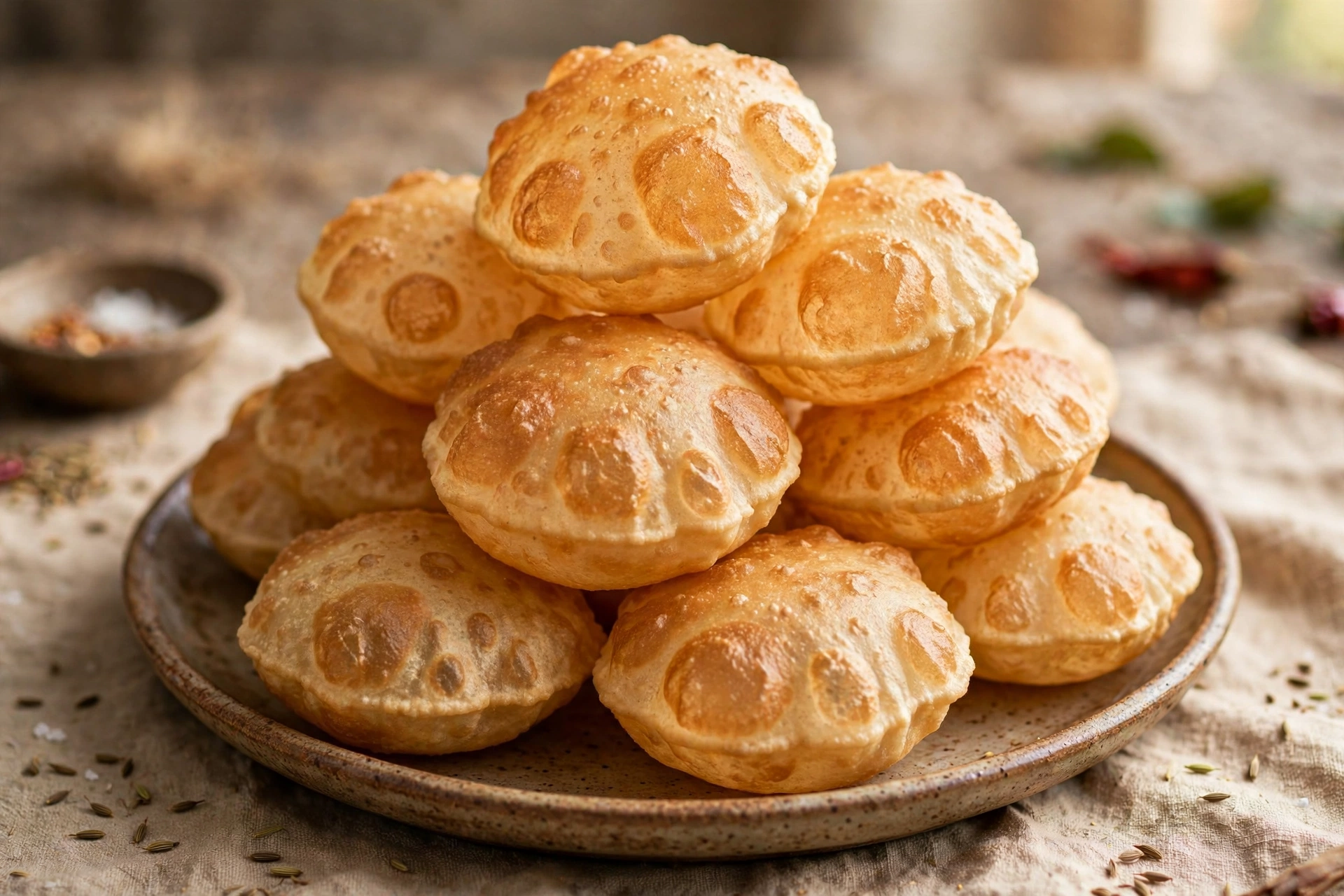
There is a small moment of pure kitchen magic when a puri hits hot oil and balloons into a perfect golden sphere. It never gets old — I still smile every single time. If you have been nervous about deep-frying bread at home, this puri recipe will walk you through it. Puris are simpler than they look: just flour, water, salt, and a little oil, rolled thin and fried for seconds.
In my house, puris mean celebration — Sunday breakfasts with aloo ki tarkari, Eid mornings, or whenever guests drop by and I want the table to feel special without spending all morning cooking. My mother always insisted that the dough must be firm, not soft like roti dough, and after years of making them I can confirm she was right about that, as she was about most things in the kitchen.
Why You’ll Love This Puri Recipe
- Only 4 basic ingredients — flour, water, salt, oil. That’s it.
- Ready in 30 minutes — including resting time for the dough.
- Fun to make — watching them puff is genuinely delightful, kids love helping.
- Versatile — pairs with curries, chana masala, halwa, or just a cup of chai.
- No yeast, no waiting — unlike bhature, there’s no fermentation involved.
Ingredients
- 2 cups (250 g) whole wheat flour (atta), plus extra for dusting
- 1/2 teaspoon salt
- 1 tablespoon neutral oil, plus more for frying (about 500 ml for deep frying)
- 3/4 cup (180 ml) lukewarm water, plus more as needed
- 1/2 teaspoon ajwain (carom seeds) — optional, but lovely
Instructions
- Make a firm dough. In a large bowl, whisk together the flour, salt, and ajwain if using. Rub in the tablespoon of oil with your fingertips until the mixture resembles coarse crumbs. Add the lukewarm water a little at a time, mixing as you go, until a firm, stiff dough comes together. This is the most important part of the puri recipe: the dough should be noticeably firmer than roti dough. Knead for 5 minutes until smooth.
- Rest the dough. Cover with a damp cloth and rest for 15 to 20 minutes. This relaxes the gluten just enough to make rolling easy. Don’t skip the rest — unrested dough springs back and fights you.
- Divide and roll. Heat your frying oil in a deep kadai or wok over medium-high heat — you’re aiming for about 175-180°C (350°F). Meanwhile, divide the dough into 12 to 14 equal balls. Roll each ball into a 4-inch circle, about 2 mm thick, on a lightly floured surface. Roll evenly; thin spots burn, thick spots stay doughy. Keep the rolled puris covered with a cloth so they don’t dry out.
- Test the oil. Drop a tiny piece of dough into the oil. It should sink briefly, then rise to the surface within 2 to 3 seconds, surrounded by lively bubbles. If it browns instantly, the oil is too hot; if it sits on the bottom, the oil is too cool.
- Fry and puff. Gently slide one puri into the hot oil — lay it away from you to avoid splashes. It will sink, then rise. Immediately and gently press it down with the back of a slotted spoon for a second; this traps steam inside and makes it puff dramatically. Flip after 10 to 15 seconds and fry the other side until light golden, about 10 more seconds. Puris cook fast — don’t walk away.
- Drain and serve. Lift out with the slotted spoon, let excess oil drip back, and drain on a wire rack or paper towels. Fry the remaining puris one at a time. Serve hot and fresh — puris wait for no one and are at their glorious best within minutes of frying.
Pro Tips
- Firm dough puffs; soft dough doesn’t. If your puris refuse to balloon, the dough was too soft or rolled too thick. Next time, use less water.
- Even thickness is everything. Roll from the center outward, rotating the dough, to get a uniform circle. Uneven puris puff lopsided or not at all.
- Oil temperature is the whole game. Too cool and puris absorb oil and turn greasy; too hot and they brown before puffing. Keep the heat steady and adjust between batches.
- Don’t overcrowd. Fry one puri at a time. Two puris cool the oil down and both suffer for it.
- Roll, then fry in batches. Roll all your puris first, then fry — once frying starts, it moves too fast to roll between batches.
- Reheat rescue. Leftover puris can be revived in a hot dry skillet for 20 seconds per side, though honestly they rarely survive long enough to need it.
FAQs
Why are my puris not puffing up?
The three usual culprits: dough too soft, puri rolled unevenly or too thick, or oil not hot enough. Fix the dough firmness first — that solves it for most people — then check your oil temperature with the test described above.
Can I make puris with all-purpose flour?
Yes, though whole wheat atta gives the traditional flavor and slightly nuttier taste. All-purpose flour makes paler, softer puris. A 50-50 mix is a nice middle ground if you’re experimenting.
Can I bake puris instead of frying?
You can bake them, but they won’t puff the same way and the texture is closer to a cracker. If you want to avoid deep frying, a better alternative is to shallow-fry in a well-oiled skillet, pressing gently — you’ll still get decent puffing.
How do I keep puris from getting soggy?
Drain them on a wire rack rather than stacked on paper towels, and don’t cover them while hot — trapped steam makes them limp. Serve within 20 minutes for maximum crispness.
Can I make the dough ahead of time?
Yes — the dough keeps well in the refrigerator for up to 24 hours in a tightly covered bowl. Let it come back to room temperature for 20 minutes before rolling, since cold dough is stiff and cracks at the edges. I often make the dough in the morning for evening guests; it actually rolls more smoothly after a longer rest.
That’s my everyday puri recipe — simple dough, hot oil, and a little confidence. Once you’ve fried your first batch and watched them puff, you’ll wonder why you ever found it intimidating. Serve them with chana masala or aloo ki bhujia, and breakfast is sorted.