Sarson Ka Saag Recipe – Authentic Punjabi Winter Greens with Makai Ki Roti
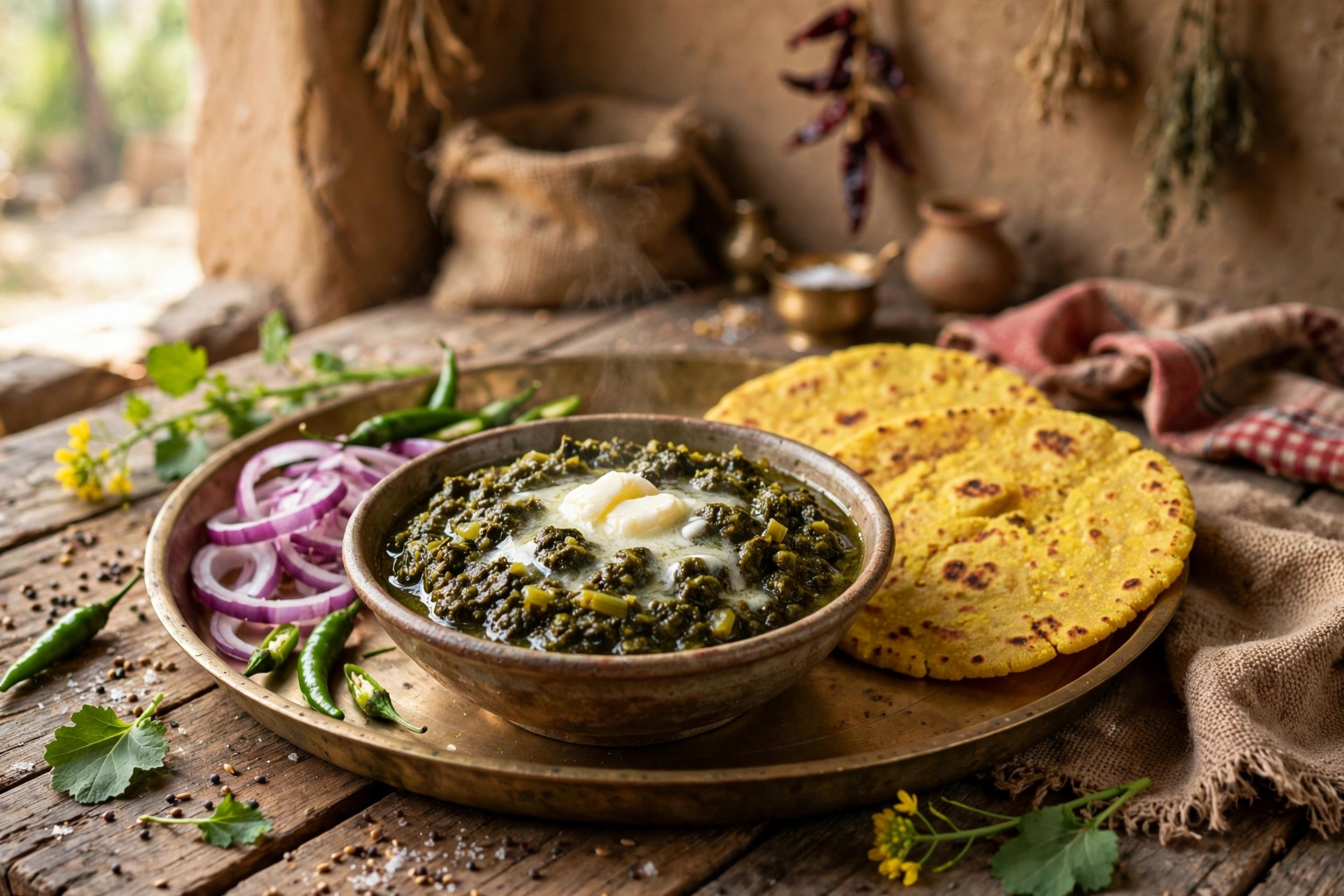
When the first cold morning hits a Punjabi village, you can smell it before you see it. Sarson ka saag simmering slowly on a wood fire, mustard greens and spinach melting into a creamy, earthy mash, and someone’s nani pressing fresh makai ki roti by hand. This is the dish winter in Punjab is built around — and honestly, once you have had the real thing with a fat swirl of white butter melting on top, nothing else tastes like December.
Sarson ka saag is not a fancy recipe. It is peasant food in the best sense: humble greens, slow fire, patience. The magic is in the slow cooking — sarson (mustard greens) boiled for hours until completely soft, then ground and simmered again with onion, ginger, green chilies, and desi ghee until it turns into this thick, buttery, deeply flavorful saag. Ghar mein banao, dhaba wala taste paao — bas time dena parta hai.
The real deal is always served with makai ki roti (yellow cornmeal flatbread) and a big dollop of homemade white butter (makhan). Here is exactly how to make it, with real measurements and every step explained.
Why You’ll Love This Sarson Ka Saag
- Authentic Punjabi flavor – slow-simmered mustard greens with desi ghee, ginger, and green chilies, the way it is made in villages.
- Naturally healthy – leafy greens packed with iron, calcium, and vitamins; no fancy ingredients needed.
- Only greens, onion, and ghee – seven or eight ingredients total, nothing you cannot find at a sabzi wala.
- Feeds a crowd – this recipe makes enough for 6–8 people, perfect for family Sunday lunch.
- Freezer-friendly – saag keeps beautifully; make a big batch and enjoy it for weeks.
Ingredients
Serves 6–8.
For the Saag
- Sarson leaves (mustard greens), washed, stems removed – 1 kg
- Palak (spinach) leaves, washed – 250 g
- Bathua leaves (optional, traditional) – 100 g
- Water – 2 cups, for boiling
- Makai ka atta (yellow cornmeal) – 2 tbsp, for thickening
- Onion, finely chopped – 1 large (about 150 g)
- Ginger, finely julienned or pounded – 2-inch piece
- Green chilies (hari mirch), chopped – 4–5 (adjust to your spice level)
- Garlic cloves, crushed – 5–6
- Desi ghee – 4 tbsp (plus more for serving)
- Salt – 1½ tsp (adjust to taste)
- Red chili powder – ½ tsp (optional)
- Homemade white butter (makhan) – for serving
For the Makai Ki Roti (makes 8)
- Makai ka atta (yellow cornmeal flour) – 2 cups (250 g)
- Salt – ½ tsp
- Ajwain (carom seeds) – ½ tsp (optional, helps digestion)
- Warm water – about ¾ cup, for kneading
- Desi ghee or oil – for cooking
Step-by-Step Instructions
Step 1: Boil the Greens (1 hour)
Put the washed sarson, palak, and bathua leaves in a large, heavy pot with 2 cups of water. Bring to a boil, then lower the heat and cover. Let the greens cook on low heat for a full hour, stirring every 15 minutes. They will release their own water and collapse into a dark green mass. Do not rush this — sarson is tough and fibrous, and it needs the full hour to soften. If the water dries up, add half a cup of hot water and continue.
Step 2: Grind to a Coarse Mash
Let the greens cool slightly, then grind them. Traditionally this is done with a wooden madhani (plunger churner) directly in the pot. A hand blender works fine too — but only pulse it. You want a coarse, rustic mash with some texture, NOT a smooth baby-food puree. The slight chew is what makes real saag. If using a mixer, blend only 10–12 seconds at a time.
Step 3: Add Cornmeal and Simmer
Mix the 2 tablespoons of makai ka atta with a little water to make a thin paste — this stops lumps. Stir it into the ground greens along with 1½ tsp salt. Put the pot back on low heat and simmer for 20–25 minutes, stirring often. The cornmeal thickens the saag and gives it that signature grainy, hearty body. The saag is ready when it is thick enough that a spoon leaves a trail.
Step 4: Make the Tarka (Tempering)
Heat 4 tbsp desi ghee in a small pan. Add the crushed garlic and fry for 30 seconds until golden — not brown, brown garlic turns bitter. Add the chopped onion and cook on medium heat for 6–7 minutes until deep golden. Add the ginger, green chilies, and red chili powder (if using). Fry for one more minute until everything smells incredible. Pour this tarka over the simmering saag and stir it in well.
Step 5: Final Simmer
Let the saag bubble gently for another 10 minutes so the tarka melts into the greens. Taste and adjust salt and green chili heat. The saag should be thick, glossy with ghee, and smell of ginger, garlic, and mustard. Turn off the heat and keep covered until serving.
Step 6: Make the Makai Ki Roti
Mix the makai atta, salt, and ajwain in a bowl. Add warm water a little at a time and knead into a soft, pliable dough — it will be more delicate than wheat dough, which is normal. Rest 10 minutes. Divide into 8 balls. Press each ball between two sheets of plastic or a damp cloth (a rolling pin works but the dough cracks easily, so press gently), shaping into a 6-inch disc. Cook on a hot tawa for 2–3 minutes per side until golden spots appear, brushing with ghee on both sides. Keep the rotis wrapped in a cloth so they stay soft.
Step 7: Serve the Punjabi Way
Scoop the hot saag into bowls, put a generous knob of white butter (makhan) on top, and let it melt into a golden pool. Serve with 2–3 makai ki roti per person, sliced onions, and a green chili on the side.
Pro Tips for Perfect Sarson Ka Saag
- Do not skip the full hour of boiling. Raw, undercooked sarson tastes bitter and fibrous. Time is the main ingredient here.
- Coarse grind, never smooth. A blender puree loses the rustic texture that defines saag. Pulse, don’t hold.
- White butter beats ghee on top. Ghee goes in the tarka, but the serving spoon of makhan on top is what makes it authentic.
- Balance the greens. Pure sarson alone can be too sharp and bitter. The palak (250 g) mellows it — that ratio matters.
- No pressure cooker shortcuts. It cooks faster, but the slow open-pot simmer builds the deep flavor. Dhaba wala taste needs time.
Variations to Try
- No-onion version – temper only ginger and green chilies in ghee for a lighter, satvik-style saag.
- Saag with gur – a piece of jaggery on the side balances the bitter greens beautifully.
- Leftover saag parathas – mix cold saag into wheat flour and roll into breakfast parathas. Zero waste, full taste.
Storage & Reheating
- Fridge: 4–5 days in an airtight container. The flavor actually improves on day two.
- Freezer: up to 2 months. Freeze in portions; thaw overnight in the fridge.
- Reheating: warm on low heat with a splash of water and a spoon of ghee, stirring well. Microwave works too — 2 minutes, stir, 2 more minutes.
FAQs
Why does my sarson ka saag taste bitter?
Almost always one of two things: the greens were not boiled long enough, or the saag was all sarson with no palak to mellow it. Keep the full hour and the 1 kg sarson to 250 g palak ratio.
Can I use canned or frozen mustard greens?
Frozen works in a pinch — thaw and squeeze dry, then reduce the boiling time to 30 minutes. Canned is not recommended; the flavor and texture are too far from fresh greens to be worth it.
What is bathua and where do I find it?
Bathua (chenopodium) is a wild winter leafy green common in Punjab and North India. Find it at desi sabzi shops in winter. If you cannot find it, just use a little extra palak — the recipe still works.
Can I make this without the makai ki roti?
Of course — saag also goes well with wheat roti or naan. But makai ki roti is half the dish; even if your first roti cracks, keep trying. The pairing is worth it.
Is sarson ka saag healthy?
Very. Mustard greens and spinach are loaded with iron, calcium, vitamin A, and fiber. It is a genuinely nutritious winter meal — just go a little easy on the ghee and butter if you are watching calories.
Conclusion
Sarson ka saag is not fast food and it never will be. It asks for an hour of slow boiling, a patient hand with the madhani, and a proper makai ki roti on the side. What it gives back is one of the great dishes of the subcontinent: earthy, buttery, deeply satisfying, with that golden pool of white butter melting over dark green saag.
Make it this weekend while the greens are fresh. Serve it the real way — makhan on top, onions on the side, roti hot off the tawa. Aur jab pehli roti toot jaye, ghabrana mat — dusri behtar banegi. Happy winter cooking!