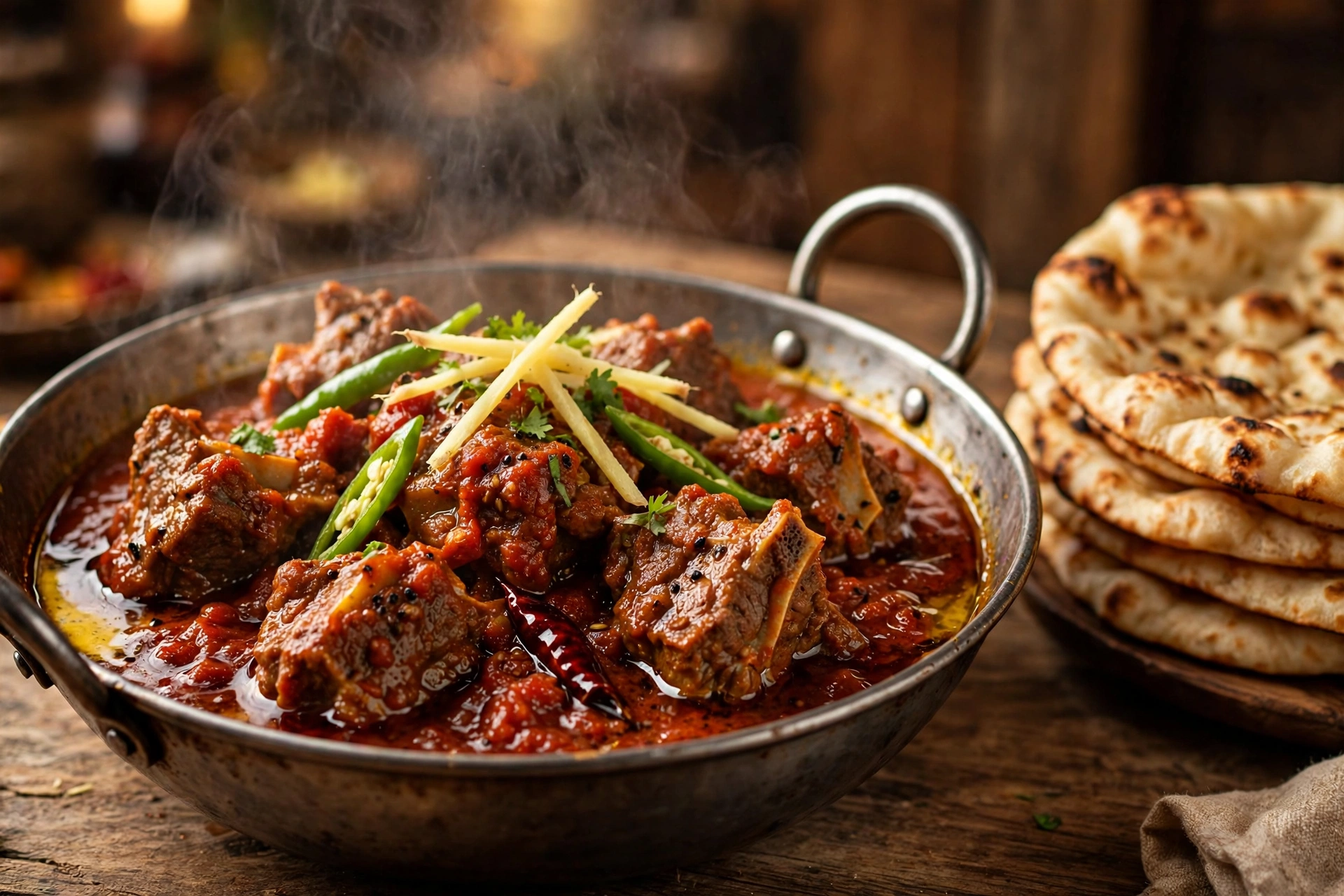
Mutton Karahi Recipe – Tender, Tomato-Rich Pakistani Mutton Karahi
There is a reason dhaba karahis are always served on a full, roaring flame. You can smell a good mutton karahi from the street — the sharp perfume of fresh tomatoes hitting hot desi ghee, the bite of green chilies, and that deep aroma that only slow-cooked mutton has. Walk into any dhaba in Lahore’s Gawalmandi or Karachi’s Burns Road at night and you will see the karahi-wala working the big wok with a long wooden spoon like a drummer, tossing the meat until every piece glistens.
Here is the thing most home cooks get wrong: mutton karahi is not a gravy dish. There is no onion paste, no yogurt base, no watery masala. The “gravy” is nothing but tomatoes, ghee, and time — cooked down until the tomatoes melt into the oil and coat every piece of meat in a thick, tangy, fiery layer. Done right, the mutton is so tender you can press it apart with a spoon. Garam naan ho aur karahi ho — bas, aur kya chahiye?
The honest version of this recipe asks for exactly one thing: patience with the mutton. Mutton needs a full simmer to go from chewy to silky — there is no shortcut around it. Everything else is simple: eight core ingredients, one karahi, and real measurements down to the spoon.
Why You’ll Love This Mutton Karahi
- Dhaba-style, at home – high-heat bhunai, a tomato-and-ghee masala, and that final full-flame toss the karahi-walas swear by.
- Fall-apart tender mutton – the slow simmer, hot water, and a yogurt trick do what rushed cooking never can.
- Only 8 core ingredients – mutton, tomatoes, ginger-garlic, green chilies, a few spices, and desi ghee.
- One-karahi cooking – everything happens in a single wok, from the first sear to the last bhunai.
- Real measurements – no “andaaza masale.” Every spoon, cup, and minute is written down.
Ingredients
Serves 5–6.
Main
- Mutton (bone-in, shoulder or leg pieces, cut into medium 1½–2 inch pieces) – 1 kg
- Fresh ripe tomatoes, roughly chopped – 750 g (about 5–6 medium)
- Desi ghee – ¾ cup (150 ml); you can swap half of it with neutral cooking oil
- Ginger-garlic paste – 2 tbsp (freshly pounded is best)
- Plain yogurt (dahi), well whisked – ½ cup (120 g); optional, but it noticeably tenderizes the meat
- Salt – 1½ tsp (adjust to taste)
- Hot water – 2 to 2½ cups, for simmering
Spices
- Red chili flakes (kuti hui lal mirch) – 2 tsp
- Crushed coriander seeds (kutaa hua dhania) – 2 tsp
- Roasted cumin powder (zeera) – 1½ tsp
- Black pepper (kali mirch), freshly cracked – 1 tsp
- Turmeric powder (haldi) – ¼ tsp (optional; purists skip it)
- Garam masala – 1 tsp (added at the very end)
For Finishing
- Fresh ginger, cut into fine juliennes – 2-inch piece
- Green chilies (hari mirch), slit – 5–6
- Fresh coriander leaves (dhania), chopped – 3 tbsp
Step-by-Step Instructions
Step 1: Sear the Mutton
Heat the desi ghee in a heavy karahi or deep wok over medium-high heat until it shimmers. Add the mutton and the ginger-garlic paste. Fry, turning often, for 10–12 minutes until the meat changes color and gets golden-brown edges all over. Do not crowd the pan — sear in two batches if your karahi is small. This browning is the first layer of flavor; pale, steamed mutton will never taste like karahi.
Step 2: Build the Tomato Masala (The Soul of the Dish)
Add the chopped tomatoes, red chili flakes, crushed coriander seeds, cumin powder, black pepper, turmeric (if using), and salt. Stir, cover, and cook on medium heat for 15–20 minutes, stirring every few minutes and mashing stubborn tomato chunks with the back of the spoon. You are done only when the tomatoes have completely melted down, the masala is a deep glossy red, and the ghee separates around the edges. Rush this step and the karahi tastes raw and sour.
Step 3: Simmer Until Fork-Tender (The Patience Step)
Pour in 2 to 2½ cups of HOT water (never cold — it seizes the meat), stir, and bring to a boil. Lower the heat, cover, and simmer gently for 45–55 minutes, stirring every 10–15 minutes. If the water dries up before the meat is tender, add another cup of hot water and keep going. Test a piece with a spoon — it should yield with gentle pressure. Give it the time it needs.
Step 4: The Yogurt Step (Tenderness Booster)
Stir in the whisked yogurt, raise the heat to medium-high, and cook uncovered for 8–10 minutes, stirring often, until the yogurt is absorbed and the ghee separates again at the edges. Purists skip this for the classic dhaba taste — but the yogurt’s gentle acidity noticeably tenderizes the meat.
Step 5: The High-Heat Bhunai (The Dhaba Moment)
Turn the flame to HIGH. Add the ginger juliennes and slit green chilies. Bhunno vigorously for 5–7 minutes, tossing constantly, until the masala clings thickly to every piece of meat and the ghee glistens at the edges. This is the step the karahi-walas do with the full flame roaring — that final blast of heat is where the flavor concentrates and the meat gets those delicious caramelized edges. Do not add water here; the thickness is the entire point.
Step 6: Finish, Rest, and Serve
Sprinkle in the garam masala, give one final toss, and turn off the heat. Scatter the fresh coriander over the top. Cover and rest for 10 minutes — the flavors settle and the masala grips the meat even better. Serve straight from the karahi with a stack of hot naan.
Pro Tips for Perfect Mutton Karahi
- Start with ripe tomatoes. Underripe, pale tomatoes make a sour, thin masala. Use deep-red, juicy ones; in winter, add 1 tbsp of tomato paste with them.
- Bone-in mutton, always. The bones release collagen and flavor into the masala during the long simmer. Boneless mutton karahi tastes noticeably flatter.
- Do not rush the tomato bhunai. A raw-tomato taste is the most common complaint in home karahis. Cook until no tomato skin is visible and the ghee separates.
- Two different fires, two different jobs. The long simmer is low and gentle; the fierce bhunai comes only in the last 5–7 minutes. Swapping them gives tough meat and a thin masala.
- Rest before serving. Ten covered minutes transforms the dish — the masala tightens around the meat and the oil rises to the top like the real thing.
Variations to Try
- White Mutton Karahi (Safed Karahi) – skip the red chili flakes and turmeric; double the black pepper to 2 tsp and finish with ¼ cup of fresh cream. Mild, creamy, and elegant.
- Pressure-cooker shortcut – after the tomato bhunai in Step 2, pressure cook for 4–5 whistles (about 15–18 minutes), then return to the karahi for the high-heat bhunai in Step 5. Faster — though the slow version tastes richer.
- Mutton karahi with extra fire – double the green chilies and add 1 tsp more chili flakes; serve with raita on the side.
FAQs
Which cut of mutton is best for karahi?
Shoulder (dasti) or leg (raan) pieces, bone-in, cut into medium 1½–2 inch pieces. Avoid overly lean cuts — a little fat keeps the meat juicy through the long simmer.
How do I make the mutton tender faster?
Always add hot water when simmering (cold water toughens the meat instantly), and do not skip the yogurt step. A pressure cooker also works — see the variations above. But time is the real tenderizer; give it the full simmer.
Why is my karahi masala watery?
Almost always under-bhunoed tomatoes or too much water. The masala is ready only when the ghee separates at the edges; then keep the final high-heat bhunai going until it clings thick to the meat.
Can I use canned tomatoes?
Fresh is traditional, but off-season you can use 800 g of canned crushed tomatoes plus 1 tbsp of tomato paste. The bhunai still takes the same patience.
How spicy is this recipe?
Medium-hot as written. For full dhaba fire, double the green chilies and add 1 tsp more chili flakes. For a milder version, halve both and remove the seeds.
Can I make mutton karahi ahead of time?
Yes — it tastes even better the next day. It keeps 3 days in the fridge. Reheat gently on low heat with a splash of hot water.
Conclusion
Mutton karahi is proof that a handful of honest ingredients, treated right, beats a long spice list every time. Tender mutton, ripe tomatoes, desi ghee, and the courage to keep the flame high at the end — that is the whole recipe. No onion paste, no complicated masala, nothing hiding in the background.
Make it this weekend. Set the karahi in the middle of the table, put a stack of hot naan next to it, and watch it disappear. Aur phir batana — kya ye dhabe-wali karahi nahi bani?