Gluten-Free Roti Recipe – Soft Millet Flatbread (No Wheat)
Ask anyone who has tried going gluten-free in a desi household and they will tell you the same story: the missing thing is never the cake or the biscuits. It is the roti. That warm, slightly charred, soft-from-the-inside flatbread sitting next to every single meal. Without it, the daal feels incomplete and the thali just does not look right.
The hard truth: you cannot just swap wheat flour for a random gluten-free flour and expect soft, puffy roti. Wheat has gluten — the protein that gives dough its stretch. Take it away, and the dough turns crumbly and the roti cracks at the edges.
But desi kitchens were making delicious gluten-free flatbreads long before anyone used the phrase “gluten-free.” Bajra (pearl millet), jowar (sorghum), ragi (finger millet) — our own traditional grains, eaten for generations across Punjab, Rajasthan, and Gujarat. The technique is different from wheat roti, but once you learn the two small tricks that make millet dough behave, you get rotis that are soft, slightly nutty, genuinely puffy, and completely wheat-free.
This recipe walks you through exactly that: which flour to use, how to knead millet dough the right way, and how to cook it so it stays soft. Real measurements, every step explained like I am standing next to you at the tawa.
One honest note: “gluten-free” here means made with naturally gluten-free millets and no wheat. If you have celiac disease or a diagnosed gluten sensitivity, check with your doctor and buy flour labeled certified gluten-free, since cross-contamination in mills is real. This is a recipe, not medical advice.
Why You’ll Love These Gluten-Free Rotis
- Truly soft, not cardboard – the hot-water kneading trick gives pliable dough and soft rotis, the thing most millet-roti attempts get wrong.
- Our own ancient grains – bajra, jowar, and ragi are desi staples with deep roots, not some imported fad flour.
- No additives – no wheat, no commercial gluten-free flour blend needed.
- Nutty, earthy flavor – different from wheat roti in a good way, and beautiful with hearty sabzis and daals.
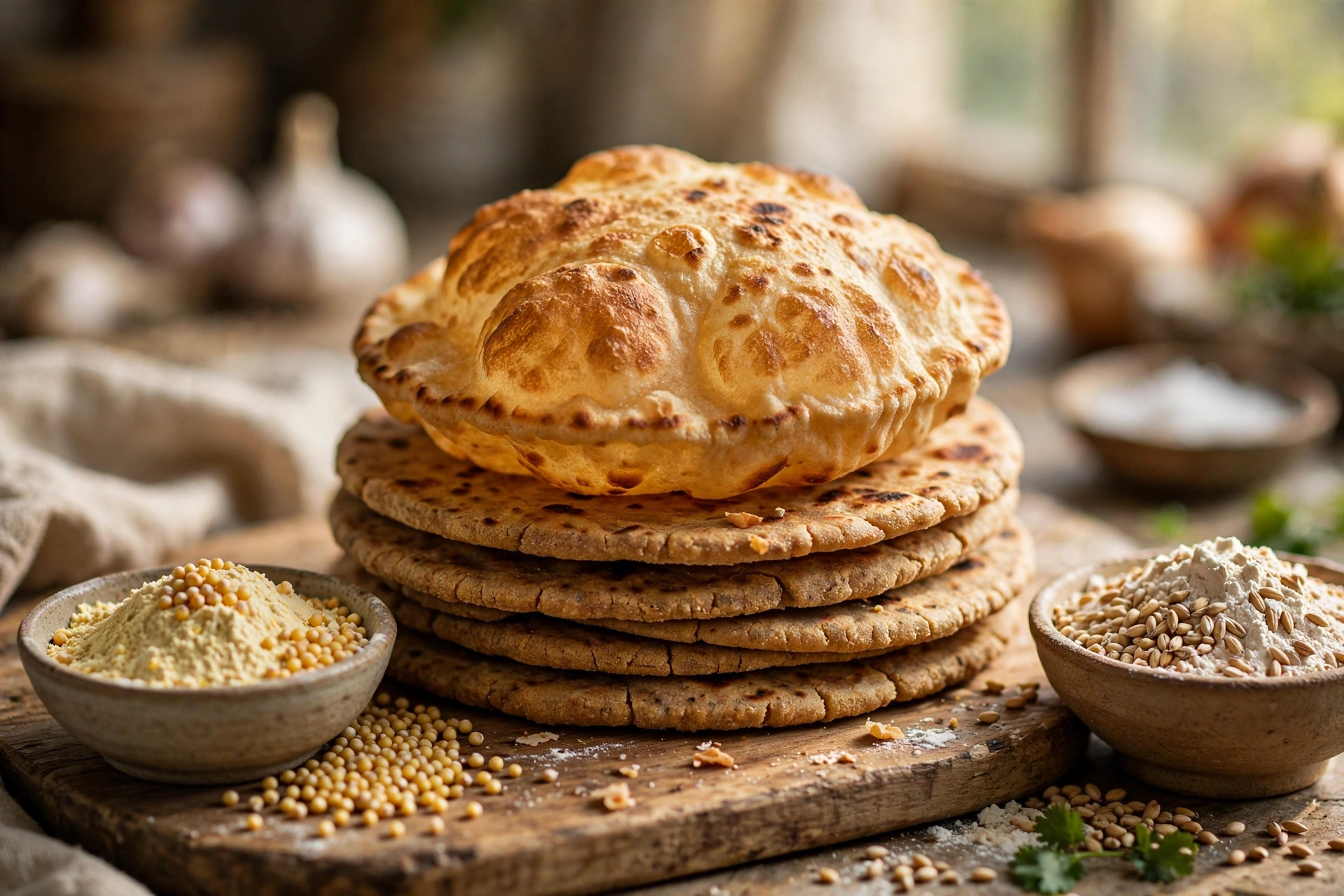
Ingredients
Makes 8 medium rotis (about 6 inches each).
For the Dough
- Jowar flour (sorghum flour), finely ground – 1 cup (130 g)
- Bajra flour (pearl millet flour) – ½ cup (70 g)
- Rice flour, finely ground – 2 tbsp (optional, adds softness)
- Salt – ½ tsp
- Ajwain (carom seeds) – ¼ tsp (optional, lovely aroma)
- Hot water (near boiling) – ¾ to 1 cup, as needed
- Ghee or oil, for kneading – 1 tsp
- Extra jowar flour, for dusting
For Cooking
- Ghee or oil, for brushing – 2–3 tsp
Which Millet Should You Use?
- Jowar (sorghum) – closest to wheat roti in texture. Mild flavor, softest result. Best for beginners.
- Bajra (pearl millet) – darker, denser, rich earthy taste. Hard to roll alone; much easier blended with jowar, as in this recipe.
- Ragi (finger millet) – deep reddish-brown, slightly sweet, very soft. You can swap the bajra for ragi one-for-one.
Buy the finest-ground flour you can find — coarse flour gives gritty rotis, fine flour gives soft ones. Use fresh flour too: millet flour turns rancid faster than wheat atta, so buy small packets and store them in an airtight jar in the fridge if your kitchen runs warm.
Step-by-Step Instructions
Step 1: Mix the Dry Ingredients
Combine the jowar flour, bajra flour, rice flour (if using), salt, and ajwain in a wide bowl or thali. Stir well so everything is evenly mixed — millet flours do not blend themselves mid-knead the way wheat flour does.
Step 2: Add Hot Water (The Crucial Step)
Heat water until just off the boil. Pour about ½ cup into the flour and stir immediately with a spoon or spatula (not your hand yet — too hot). It will look shaggy and lumpy. Keep adding hot water a splash at a time, stirring, until it clumps into a rough mass — roughly ¾ to 1 cup total.
Why hot water? Millet flour has no gluten, so hot water partially cooks the starches — that is what binds and softens the dough. Lukewarm water gives crumbly dough that cracks when rolled. This single step decides soft rotis versus heartbreak.
Step 3: Knead Warm
When the mixture is cool enough to touch (warm, not scalding — wait 3–4 minutes), add the teaspoon of ghee or oil and knead for 5–6 minutes. Press, fold, turn. The dough should become smooth, soft, and pliable, like soft play-dough. If it feels dry and cracks, wet your hands and knead in a splash more warm water. If sticky, dust in a little jowar flour. Millet dough will never be as elastic as wheat dough — smooth and soft is what you are after.
Step 4: Rest the Dough
Cover with a damp cloth or a plate and rest 15–20 minutes. This lets the flours fully hydrate and makes rolling much easier. Do not skip it.
Step 5: Shape the Rotis
Divide the dough into 8 equal balls. The easiest method: flatten a ball with your palm, dust lightly with jowar flour, place it between two sheets of butter paper (or a folded plastic bag), and roll gently from the center outward, turning once or twice, until you have a 6-inch round a couple of millimeters thick. Be gentle — pressing hard cracks the edges.
The traditional way is to wet your palms and pat the ball out by hand on a chakla — hand-patted bajra rotis are the village classic. Either works; the paper method is more forgiving.
Step 6: Cook on the Tawa
Heat a tawa or heavy flat pan over medium-high heat — properly hot, not smoking. Peel the roti off the sheet and lay it on the tawa. Cook 30–40 seconds until small bubbles appear, then flip. Cook the second side about a minute, flip again, and press gently all over with a folded cloth or flat spatula. If the tawa is hot enough, the roti will puff up — that puffing is the sign of success. Cook until both sides have light golden-brown spots, about 2–3 minutes total.
Step 7: Brush with Ghee and Serve
Transfer each roti straight to a cloth-lined basket and brush lightly with ghee or oil. Stacking them under a cloth keeps them soft and steamy. Serve hot — millet rotis are at their absolute best fresh off the tawa.
Pro Tips for Soft Millet Rotis
- Water must be genuinely hot. Warm water is the number one reason millet rotis crack. Near-boiling is the target.
- Fine flour, fresh flour. Coarse or stale millet flour cannot be rescued by technique.
- Do not roll too thin. Medium thickness (2–3 mm) is the sweet spot — thinner dries out and cracks, thicker cooks unevenly.
- Keep the tawa hot. A half-hot tawa dries the roti out before it cooks through.
- Serve fresh. Millet rotis firm up as they cool — normal for the grain. Reheat 15 seconds on a hot tawa, or wrapped in a damp cloth in the microwave for 20 seconds, and they come back soft.
- Cracked edges? Usually the water was not hot enough, the dough was under-kneaded, or it did not rest. Fix those and try again.
Variations to Try
- Ragi-Jowar Roti – swap the bajra for an equal amount of ragi flour for a softer, slightly sweet, deep-brown roti kids often prefer.
- Missi-style millet roti – knead in 2 tbsp finely chopped onion, 1 chopped green chili, a handful of chopped methi, and ½ tsp crushed coriander seeds for a savory breakfast roti.
FAQs
Are millet flours really gluten-free?
Yes — bajra, jowar, and ragi are naturally gluten-free grains. The caution is cross-contamination in milling facilities. For diagnosed celiac disease, buy certified gluten-free flour. For general wheat-free eating at home, regular millet flour is fine.
Why does my millet dough keep cracking when I roll it?
Almost always the water was not hot enough, or the dough was not kneaded and rested. Add hotter water, knead the full 5–6 minutes, rest 15–20 minutes — and make sure your flour is finely ground.
How should I store leftover rotis?
Stack with a cloth between, wrap in foil or a clean kitchen towel, and keep at room temperature for a day. Reheat on a hot tawa with a light brush of ghee and they come back soft. Do not refrigerate uncovered — the fridge dries them out.
Which sabzis pair best with millet roti?
Hearty, gravy-rich ones: sarson ka saag, daal makhani, chana masala, baingan bharta, or any slow-cooked sabzi. The nutty flavor of the roti loves a rich, comforting partner.
Conclusion
Going wheat-free does not have to mean giving up the centerpiece of the desi thali. With hot water, a little patience, and our own traditional millets, you get rotis that puff, stay soft, and taste like they belong next to your favorite sabzi — because they do. Jowar and bajra fed our grandparents long before wheat took over the modern kitchen; we are just inviting them back to the table.
Try this recipe this week. Make the dough with properly hot water, rest it, roll gently — and tell me: kya ye asli ghar-wali roti nahi bani?