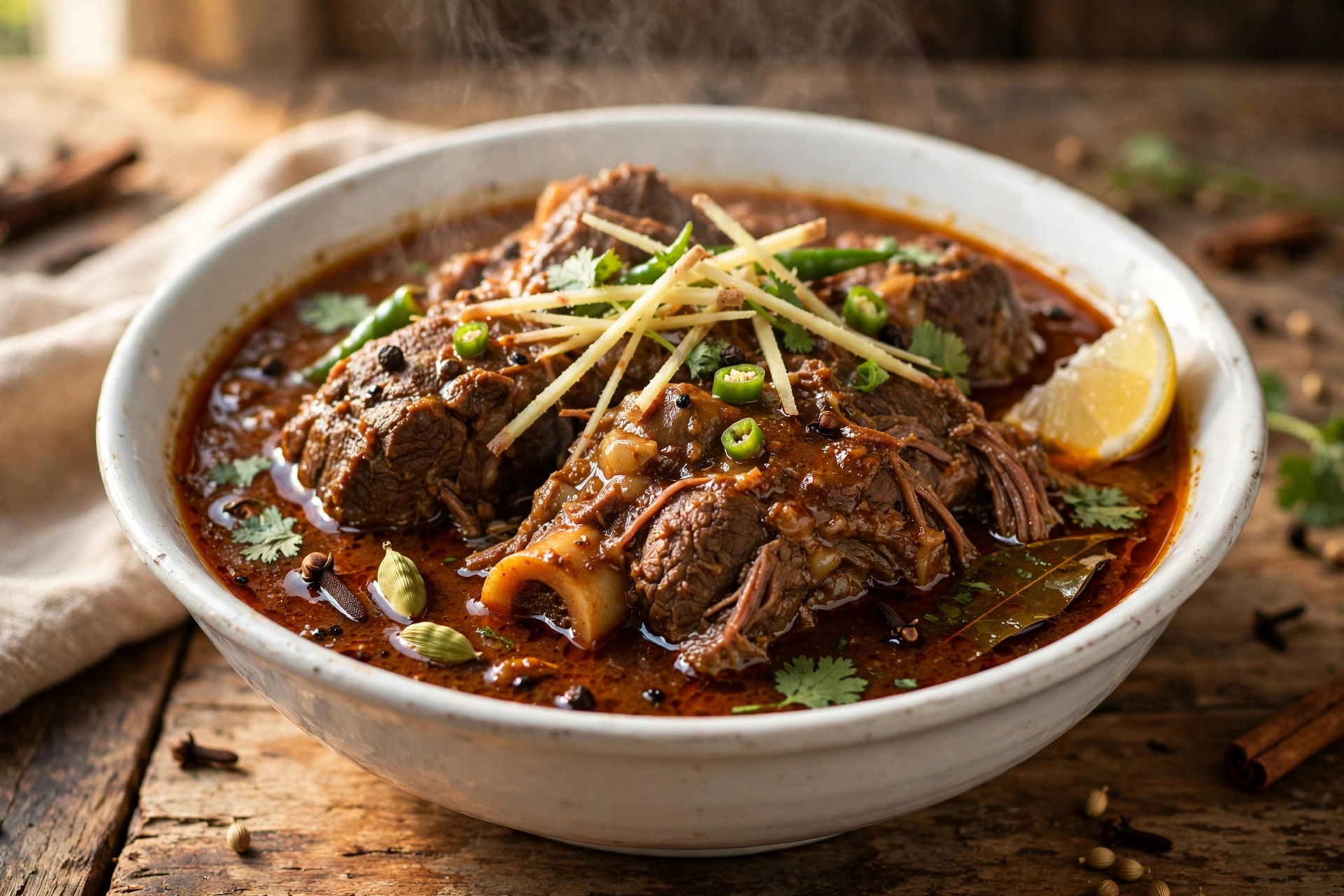
There’s curry, and then there’s nihari — the dish that made grown men set alarms for 5 a.m. Beef nihari is shank simmered for hours until the meat falls off the bone and the gravy turns thick, glossy, and deeply spiced. Marrow melts into the gravy, homemade masala blooms in hot ghee, and it’s scooped up with hot naan, ginger, green chilies, and lemon. This is not weeknight cooking. This is the crown of Pakistani cuisine.
My first real nihari was at a tiny shop in an old-city bazaar, with a giant deg simmering since midnight. Just after dawn, the owner ladled it from the center of the pot where the gravy was thickest. The shank collapsed under the naan; the gravy was silky and brick-red, warm with fennel and black cardamom. In four bites I understood why Lahore and Karachi treat nihari like fine dining. It was breakfast, and one of the best things I’d ever eaten.
Great nihari needs four things: bone-in shank (never boneless — the bones and marrow are the point), freshly ground masala, the atta slurry that turns gravy to silk, and time. Four to five hours of gentle simmering makes tough shank spoon-tender. A pressure cooker can approximate it, but the slow pot goes deeper. Start after lunch on a weekend; eat like royalty at dinner.
Why You’ll Love This Beef Nihari Recipe
- Fall-off-the-bone shank — slow simmering turns tough shank into meat you can cut with a spoon.
- Homemade nihari masala — freshly toasted and ground spices that put packet masalas to shame.
- Silky, glossy gravy — the traditional atta slurry gives nihari its signature body.
- Authentic old-city flavor — fennel, black cardamom, and dried ginger, like the nihari houses make.
- A true weekend showstopper — serve with hot naan and watch the table go quiet.
Ingredients
For the nihari masala (makes about 5 tablespoons — you’ll use 3):
- Fennel seeds — 2 tablespoons
- Cumin seeds — 1 tablespoon
- Coriander seeds — 1 tablespoon
- Black peppercorns — 1 teaspoon
- Whole cloves — 8 to 10
- Green cardamom pods — 6
- Black cardamom pods — 2
- Cinnamon stick — 2-inch piece, broken
- Bay leaves — 2
- Dried Kashmiri red chilies — 3 to 4
- Nutmeg — 1/4 piece, or 1/2 teaspoon freshly grated
- Mace blades — 2
- Dried ginger powder (sonth) — 1 teaspoon
For the stew:
- Beef shank — 1.5 kg (about 3.3 lbs), bone-in, cut into 3 to 4-inch pieces
- Desi ghee — 1/2 cup (120 ml); or 1/3 cup ghee plus 1/3 cup neutral oil
- Onions — 2 large, thinly sliced (about 300 g)
- Fresh ginger-garlic paste — 3 tablespoons
- Salt — 2 teaspoons, plus more to taste
- Water — 8 to 10 cups (2 to 2.5 liters)
- Whole wheat flour (atta) — 5 tablespoons, for the slurry
- Desi ghee — 3 tablespoons, for the final tarka
For serving:
- Fresh ginger — 1-inch piece, cut into fine juliennes
- Fresh green chilies — 3 to 4, sliced lengthwise
- Fresh coriander leaves — a handful, chopped
- Lemon — 1, cut into wedges
- Hot naan or khamiri roti
Instructions
- Toast and grind the masala. Toast all the whole spices in a dry heavy skillet over medium heat for 2 to 3 minutes, shaking constantly, until the fennel darkens and the kitchen smells like a spice market. Don’t walk away — burnt spices turn the nihari bitter. Cool five minutes, grind fine, and mix in the dried ginger powder. Use 3 tablespoons; store the rest airtight for up to a month.
- Brown the shank in ghee. Heat the 1/2 cup ghee in your heaviest wide pot over medium-high heat until shimmering. Sear the shank in two batches, 3 to 4 minutes per side, until deeply browned — this builds the fond, the caramelized crust that dissolves into the gravy for color and depth. Crowding steams the meat, so don’t rush the batches.
- Soften the onions. In the same pot, cook the sliced onions over medium heat for 10 to 12 minutes, stirring often, until soft, sweet, and golden at the edges — they should melt into the gravy, not crisp. Stir in the ginger-garlic paste and cook 2 more minutes until the raw smell is gone. If the pot catches, splash in two tablespoons of water and scrape; that browned goodness belongs in the gravy.
- Add masala and meat. Sprinkle in the 3 tablespoons of nihari masala and the salt; stir 30 seconds until the spices bloom. Return the shank with its juices, coating each piece. Pour in 8 cups of water (about two inches above the meat), bring to a rolling boil, and scrape the bottom once more.
- Slow-cook 4 to 5 hours. Drop to the lowest flame — the laziest simmer, a bubble every few seconds. Cover partially, lid ajar, so the gravy reduces. Check hourly with a gentle stir, skimming foam in the first hour. The meat is done when it yields to a spoon and pulls from the bone — usually around 4 hours, sometimes 5. Top up with hot water a cup at a time if needed. High heat toughens the meat and clouds the gravy; low and slow is the entire philosophy. “Nihar” means morning — it was cooked overnight and eaten at dawn.
- Make the atta slurry. Whisk the 5 tablespoons of atta into 1 cup of cool water until completely smooth — cool water, never warm, or the flour seizes into lumps. This slurry is what gives nihari its body; without it you have spiced beef soup, not nihari.
- Thicken the gravy. At a gentle simmer, pour the slurry in a thin stream while stirring constantly. Stir 2 minutes as it thickens, then simmer 30 to 40 minutes more, stirring every 10 minutes. The gravy should coat a spoon heavily, turn glossy and brick-red, with little pools of ghee glistening on top — that shimmer is the mark of proper nihari, not a flaw. Taste and adjust salt; the flour dulls seasoning, so it usually needs a final pinch.
- Finish with the ghee tarka and rest. Heat the 3 tablespoons of ghee until hot but not smoking, pour it sizzling over the nihari, and stir once — this blooms the spices one last time. Rest covered for 15 minutes so the gravy settles. Ladle into wide bowls, each with a shank piece and its bone (the marrow is the prize). Top with ginger, green chilies, coriander, and lemon. Serve immediately with blistering-hot naan. There is no polite way to eat nihari; embrace the mess.
Pro Tips
- Bone-in shank or nothing. Boneless beef makes a tasty stew, never nihari. The bones release marrow and collagen over the long cook — that’s the body and richness. Ask your butcher for shank cut for nihari.
- Grind the masala fresh. Pre-ground spices lose their oils within weeks. Ten minutes of toasting and grinding is the highest-return step here.
- Keep the simmer lazy. Vigorous bubbling tightens the meat and clouds the gravy. A bubble every few seconds is the pace.
- Lump-free slurry, always. Cool water, whisked smooth, poured in a thin stream while stirring.
- Don’t fear the fat. The glistening ghee layer is the dish’s signature. Chilling overnight and lifting it off works if you must — but the regulars would call it a tragedy.
- Better the next day. Nihari deepens overnight in the fridge. Make it a day ahead and reheat gently, doing the ghee tarka fresh.
Serving Suggestions
Nihari demands naan — hot, blistered, torn by hand, used as both spoon and plate. Khamiri roti from a tandoor is the traditional partner if you can find it. The garnishes are essential: ginger for sharpness, green chilies for heat, lemon to cut the richness, coriander for its clean herbal note. Sliced raw onions with salt on the side is classic. And since nihari is famously breakfast in Lahore and Karachi, don’t feel bound by mealtimes — magnificent at 7 a.m., equally so at 8 p.m. Leftover gravy makes an outrageous next-morning breakfast with paratha.
FAQs
Can I make nihari with boneless beef?
You can, but it will be a beef stew, not true nihari — the bones and marrow define the dish. If shank is unavailable, bone-in short ribs are the next best choice. Keep the atta slurry and the full slow cook.
Can I use a pressure cooker?
Yes — 35 to 40 minutes at full pressure, then release, add the slurry, and simmer uncovered 20 minutes to thicken. Very good, but the slow version has a depth the cooker can’t fully match. Do it the slow way at least once.
Why is my nihari gravy thin?
Usually the slurry was too thin or it didn’t simmer long enough — give it the full 30 to 40 minutes. Keep the lid ajar during the long cook; a sealed lid traps steam and prevents reduction.
Can I use store-bought nihari masala?
In a pinch, use 3 tablespoons of a good brand. But homemade takes ten minutes and the difference is dramatic — fresher, more aromatic, no excess salt or fillers.
How do I store leftover nihari?
Refrigerate up to 4 days — the flavor deepens overnight. It freezes well for up to 3 months; thaw overnight and reheat gently with a splash of water. Garnish fresh when serving.
That’s real nihari: bone-in shank, a masala you ground yourself, five unhurried hours, and a gravy thick enough to make a spoon stand up. The first time you drag that tender meat through the glossy gravy with hot naan, you’ll understand why people have woken before dawn for it for two hundred years.