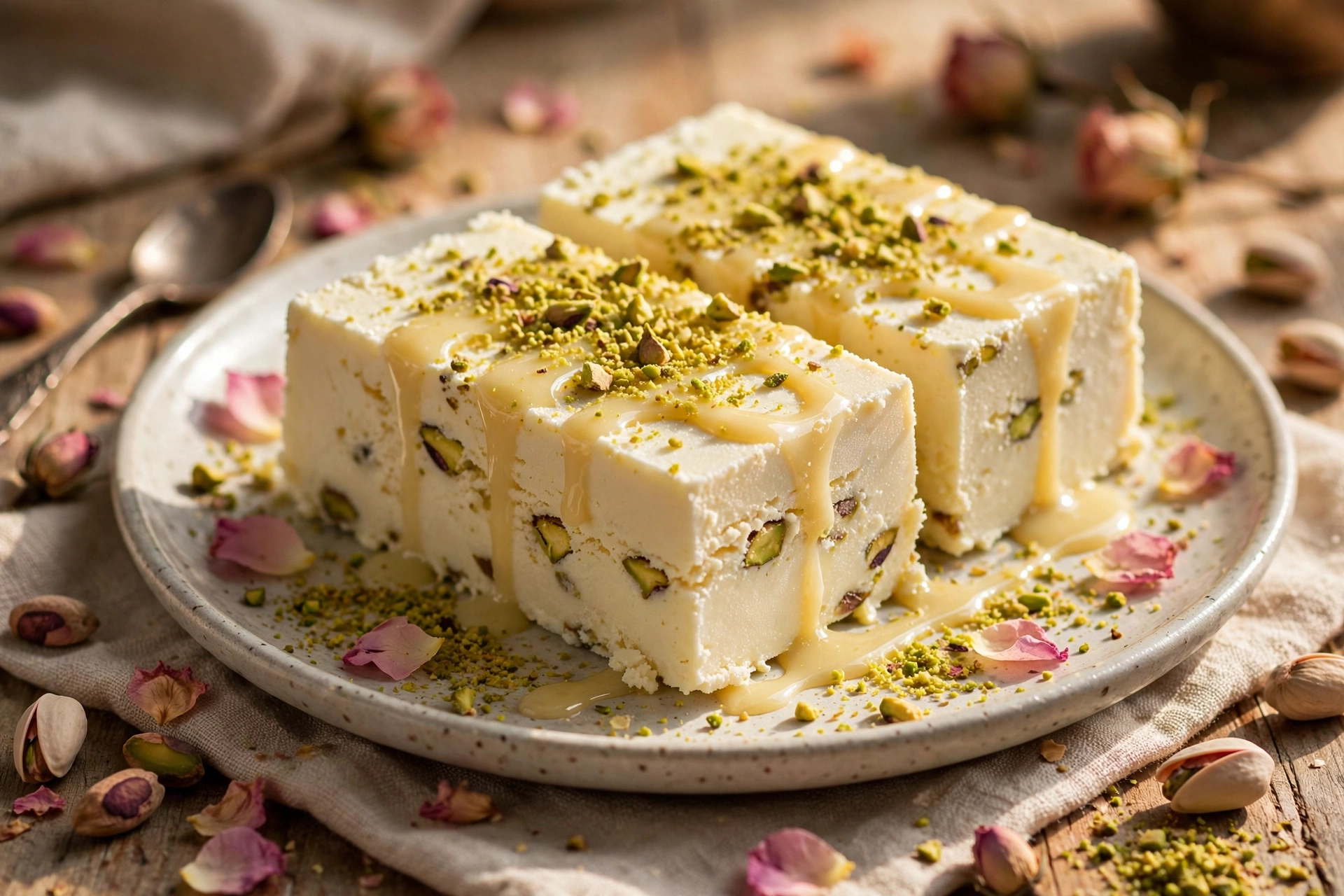
Of all the frozen desserts in the world, kulfi is the one with the most character. Dense, creamy, faintly caramelized from slow-cooked milk, perfumed with cardamom and crowned with pistachios — this kulfi recipe makes the traditional version, reduced patiently on the stovetop, with none of the shortcuts that turn it into just another ice cream. If you’ve only ever had the icy, overly sweet kind from a street cart of questionable quality, you’re in for a revelation.
My grandmother made kulfi every summer in the tall aluminum kulfi molds that lived in the back of her freezer. The process took most of an afternoon: a big pot of milk, reduced slowly while she did other things, stirred whenever she walked past the stove. The kitchen would fill with the smell of caramelizing milk — sweet, toasty, unmistakable. Then the molds went into the freezer, and the next day we’d get them as the reward for surviving the heat. No churn, no machine, no condensed milk shortcuts. Just milk, sugar, and patience.
That patience is the entire secret of a proper kulfi recipe. The slow reduction does three things at once: it thickens the milk so the kulfi sets dense instead of icy, it caramelizes the milk sugars for that distinctive toasty depth, and it concentrates the flavor so every bite tastes intensely of milk rather than just sweetness. Modern shortcut versions using condensed milk and cream are faster, but they taste flat next to the real thing — sweet without soul.
This recipe follows the traditional method with a few practical refinements I’ve learned over the years: a wider pot for faster reduction, cornstarch as insurance for a smooth set, and the exact freezing technique that prevents ice crystals. Plan for about 90 minutes of mostly hands-off cooking, plus overnight freezing. The result is worth every minute.
Why You’ll Love This Kulfi Recipe
- Authentic slow-cooked flavor — the caramelized milk depth you can’t get from shortcut versions.
- No ice cream maker needed — kulfi is traditionally still-frozen; the dense texture comes from reduced milk, not churning.
- Dense and creamy, never icy — the reduction plus a little cornstarch gives a smooth, firm set.
- Endlessly customizable — cardamom and pistachio are classic, but mango, saffron, and rose all work beautifully.
- Make-ahead perfect — it has to freeze overnight anyway, so it’s ideal for dinner parties.
Ingredients
- Whole milk — 1.5 liters (about 6.25 cups); full-fat is essential, not optional
- Sugar — 1/2 cup (100 g), adjust to taste
- Cornstarch — 2 tablespoons (16 g), dissolved in 3 tablespoons cold milk
- Green cardamom — 4 pods, seeds crushed to a powder (or 1/2 teaspoon ground cardamom)
- Saffron — a generous pinch (about 15 strands), soaked in 1 tablespoon warm milk (optional but lovely)
- Pistachios — 3 tablespoons, roughly chopped, plus extra for serving
- Almonds — 2 tablespoons, slivered (optional)
- Rose water — 1 teaspoon (optional)
- A pinch of salt — sharpens all the flavors
Instructions
- Set up for reduction. Pour the milk into the widest heavy-bottomed pot or karahi you own — surface area is everything here, because evaporation is what reduces the milk, and a wide pot can cut your cooking time nearly in half compared to a tall narrow one. Bring it to a gentle boil over medium heat, then reduce to a steady simmer. From here on, stir every 5 to 7 minutes, scraping the bottom and sides, because milk scorches easily and even a faintly burnt taste will ruin the whole batch. This isn’t active cooking so much as attentive hovering — perfect for a lazy afternoon when you’re in and out of the kitchen anyway.
- Reduce the milk. Let the milk simmer and reduce for 60 to 75 minutes, stirring regularly, until it’s thickened to roughly half its original volume. You’ll see it change in stages: first it just looks like hot milk, then it starts coating the spoon, then it develops a pale golden color and a rich, caramelly smell that fills the kitchen. A skin will form on top between stirrings — just stir it back in; that’s concentrated flavor. The milk is ready when it coats the back of a spoon thickly and has reduced to about 3 cups. Don’t rush this with high heat; a scorched bottom means starting over.
- Sweeten and flavor. Stir in the sugar and the pinch of salt, and continue simmering for 5 minutes until the sugar fully dissolves. Now whisk in the cornstarch slurry (stir it again right before adding, as cornstarch settles fast) and cook for 2 to 3 minutes, stirring constantly, until the mixture thickens noticeably — it should fall from the spoon in thick ribbons. This is your insurance against iciness. Turn off the heat and stir in the crushed cardamom, the saffron with its soaking milk, and the rose water if using. Taste it now: it should taste slightly too sweet and slightly too intense, because freezing dulls both sweetness and flavor.
- Cool completely. Transfer the mixture to a bowl and let it cool to room temperature, stirring occasionally to prevent a skin from forming — or lay plastic wrap directly on the surface. Then refrigerate until thoroughly cold, at least 2 hours. Never pour warm kulfi base into molds and freeze; it freezes unevenly and develops ice crystals. Cold base, cold molds, cold freezer — that’s the formula for dense, smooth kulfi.
- Mold and freeze. Stir the chopped pistachios and almonds into the cold base. Pour into kulfi molds, popsicle molds, or even small paper cups — fill them nearly to the top, as kulfi doesn’t expand much. If your molds have lids, use them; otherwise cover tightly with foil and poke a popsicle stick or skewer through the center of each. Freeze for at least 8 hours, ideally overnight. The long, slow freeze is what sets the dense texture, so don’t try to rush it with a colder setting — steady and slow wins.
- Unmold and serve. To unmold, run each mold under warm (not hot) water for 10 to 15 seconds, then gently twist and slide the kulfi out. If using paper cups, just peel them away. Arrange on a chilled plate, sprinkle with extra chopped pistachios, and serve immediately — kulfi melts faster than ice cream because of its density, and it’s at its best in the first few minutes out of the freezer, firm and cold with that intense milky flavor.
Pro Tips
- Full-fat milk is mandatory. Low-fat or skim milk won’t reduce to the right richness and gives icy kulfi. This is not the recipe to lighten up.
- Wide pot, medium heat. The single biggest time-saver. A 12-inch karahi reduces 1.5 liters in about an hour; a tall stockpot can take nearly two.
- Stir the bottom, not just the top. Milk scorches from the bottom up. Every stir should scrape the base of the pot thoroughly.
- Taste the base warm. It should taste slightly over-sweet now — freezing mutes sweetness by about 20 percent. Adjust sugar before it cools.
- Freeze overnight, minimum 8 hours. Kulfi eaten too early is soft and disappointing. Patience at the freezer stage matters as much as patience at the stove.
- Warm water, not hot, for unmolding. Hot water melts the outside too fast and you lose the smooth surface. Ten seconds under warm tap water is perfect.
Serving Suggestions
Classic kulfi needs nothing more than chopped pistachios on top, served on a chilled plate. For something special, serve it with falooda — the combination of dense kulfi, vermicelli, basil seeds, and rose syrup is one of the great desserts of the world. It’s also wonderful sliced and served alongside fresh mango in summer, or with a drizzle of warm rabri for the full traditional treatment. At dinner parties, I unmold them onto individual small plates and let guests add their own pistachios — it looks elegant with almost no effort.
FAQs
Why is my kulfi icy instead of creamy?
Three likely causes: the milk wasn’t reduced enough (it must halve in volume), the base went into the freezer warm, or it was frozen for too short a time. The reduction is the main factor — shortcut versions that skip it almost always turn icy. Make sure your base is thoroughly cold before molding and give it the full overnight freeze.
Can I make kulfi without molds?
Yes. Pour the base into a loaf pan or shallow freezer-safe container, freeze until firm, then slice. It won’t have the classic shape, but the taste is identical. You can also freeze it in small ramekins or even a muffin tin lined with plastic wrap.
Can I use condensed milk to speed this up?
You can, but it won’t taste like traditional kulfi. The shortcut version — condensed milk plus cream plus cardamom, frozen — is pleasant but one-dimensionally sweet, missing the caramelized depth that makes real kulfi special. If you’re short on time it’s an acceptable compromise, but try the slow version at least once to know what you’re aiming for.
How long does kulfi keep in the freezer?
Well-wrapped (each piece in plastic wrap, then in a freezer bag), kulfi keeps for up to 2 months. After that it’s still safe but can pick up freezer flavors. Thaw for 5 minutes at room temperature before serving for the best texture.
Can I make mango kulfi with this recipe?
Absolutely — it’s a wonderful variation. Reduce the sugar to 1/3 cup, and fold 1 cup of thick mango pulp (from sweet, ripe mangoes) into the cold base before molding. Skip the rose water and let the mango be the star. Everything else stays the same.
That’s the traditional method, the way my grandmother made it and the way I still make it every summer. Yes, it takes an afternoon — but most of that is the pot simmering away while you get on with your day, and the reward is kulfi with a depth of flavor no shortcut can touch. Make this kulfi recipe once the slow way, and you’ll understand why some of us are stubborn about it.