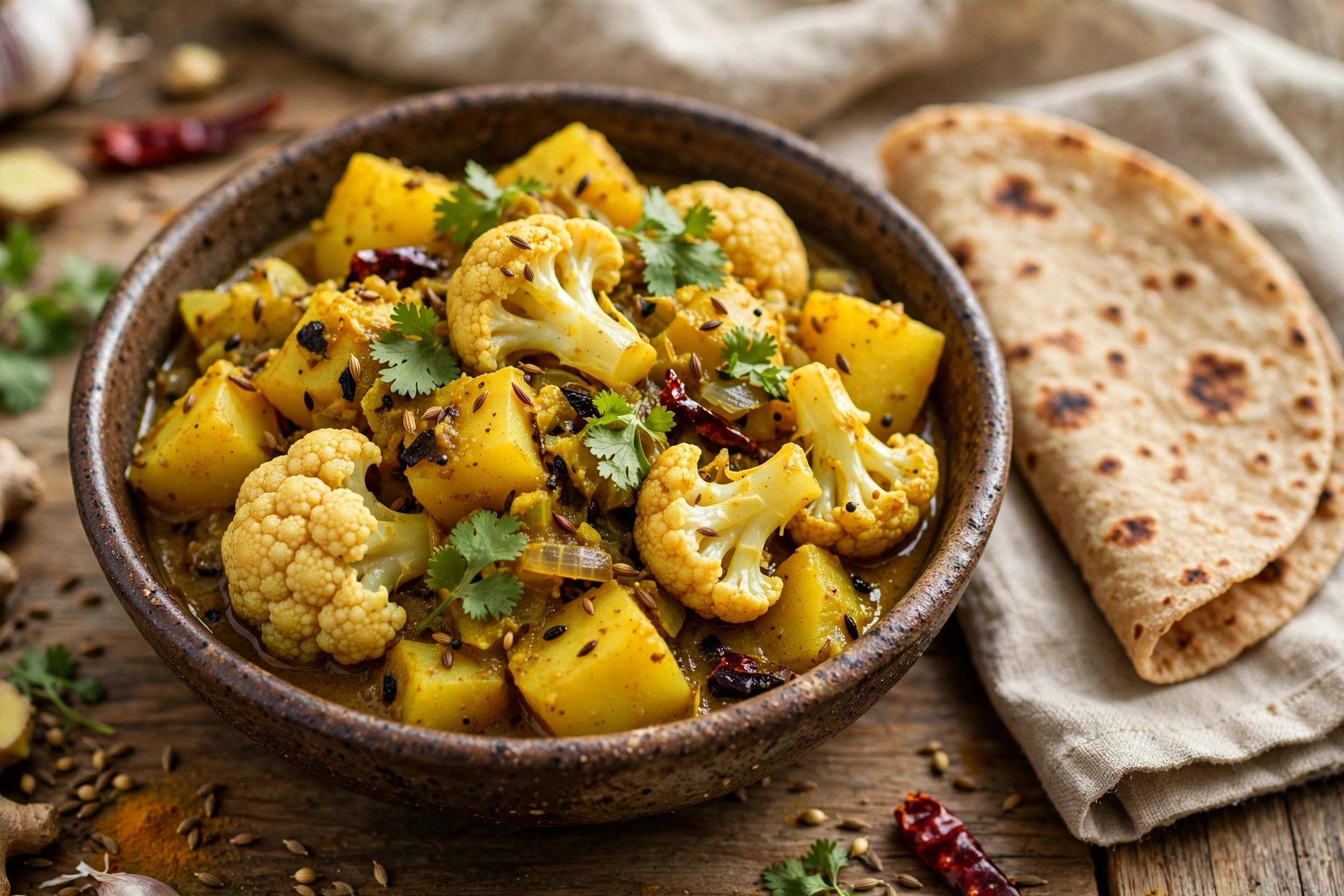
If there’s one curry that proves simple vegetables can carry a whole meal, it’s this aloo gobi recipe. Potatoes and cauliflower, cooked down with tomatoes, ginger, and a careful hand with the spices until everything is tender and golden at the edges — no cream, no complicated technique, just honest home cooking. This is the dish my family makes when the fridge is nearly empty and somehow it still tastes like a feast.
I learned to cook aloo gobi from watching my aunt, who never measured anything and somehow produced the same perfect result every time. Her secret, which took me years to understand, wasn’t in the spice quantities at all — it was patience. She let the cauliflower sit undisturbed in the hot pan until the edges caught and caramelized, and she never added water until the tomatoes had completely melted into the masala. “The vegetables make their own gravy,” she used to say, “if you let them.” She was right.
The version I’m sharing here follows her method closely. We fry the potatoes and cauliflower first so they develop color and structure, then build a proper tomato-ginger masala, then let everything finish together until the potatoes are creamy inside and the cauliflower is tender but not mushy. The result is a dry-ish curry — not soupy — with deep, roasted flavor in every bite.
This aloo gobi recipe is naturally vegan, uses one pan, and takes about 40 minutes from chopping to serving. It’s the kind of recipe that belongs in every home cook’s regular rotation, and once you nail the technique, you’ll find yourself making it weekly.
Why You’ll Love This Aloo Gobi Recipe
- One pan, minimal cleanup — everything happens in a single wide pan or karahi.
- Naturally vegan and gluten-free — no substitutions needed, it’s just vegetables and spices.
- Deep, roasted flavor — the initial frying step gives you caramelized edges you can’t get from steaming.
- Budget-friendly — potatoes and cauliflower are among the cheapest vegetables you can buy.
- Meal-prep friendly — tastes even better the next day as the spices settle in.
- endlessly versatile — serve with roti, paratha, or rice; it works with all of them.
Ingredients
- Cauliflower — 1 medium head (about 600 g), cut into bite-sized florets
- Potatoes — 3 medium (about 400 g), peeled and cut into 1-inch cubes
- Neutral oil — 4 tablespoons (60 ml), divided
- Cumin seeds — 1 teaspoon
- Onion — 1 large, finely chopped
- Fresh ginger — 1 tablespoon, grated (about a 1-inch piece)
- Garlic — 3 cloves, minced
- Green chilies — 2, slit lengthwise (adjust to taste)
- Tomatoes — 2 medium (about 300 g), finely chopped; or 1 cup (240 ml) canned crushed tomatoes
- Ground turmeric — 1/2 teaspoon
- Ground cumin — 1 teaspoon
- Ground coriander — 1.5 teaspoons
- Garam masala — 1/2 teaspoon
- Kashmiri red chili powder — 1/2 teaspoon (for color; adjust heat to taste)
- Salt — 1.25 teaspoons, or to taste
- Water — 1/4 cup (60 ml), only if needed
- Fresh coriander leaves — 2 tablespoons, chopped
- Lemon juice — 1 teaspoon, fresh (optional but brightens everything)
Instructions
- Prep the vegetables. Cut the cauliflower into even, bite-sized florets — not too small or they’ll disintegrate, not too big or they won’t cook through. Cube the potatoes into roughly 1-inch pieces so they cook at the same rate as the cauliflower. Keep them in separate bowls for now. Chop the onion, grate the ginger, mince the garlic, and have all your ground spices measured into a small bowl. Aloo gobi moves in stages, and having everything ready means you won’t burn the spices while hunting for the turmeric.
- Fry the potatoes and cauliflower. Heat 3 tablespoons of oil in a large, wide pan or karahi over medium-high heat. When the oil shimmers, add the potato cubes in a single layer and let them cook undisturbed for 3 to 4 minutes until the bottoms are golden. Stir, then add the cauliflower florets. Continue cooking, stirring occasionally, for 7 to 8 minutes until both vegetables have golden, slightly crisp edges. This step is what separates good aloo gobi from bland aloo gobi — the caramelization builds a depth of flavor that no amount of spice can fake. Remove the vegetables to a plate; they’ll finish cooking later.
- Build the masala base. In the same pan, add the remaining tablespoon of oil if the pan looks dry. Drop in the cumin seeds and let them sizzle for 20 seconds until fragrant. Add the chopped onion and cook over medium heat for 6 to 7 minutes, stirring regularly, until soft and golden at the edges — not just translucent, actually golden, because that sweetness is the backbone of the curry. Add the ginger, garlic, and green chilies and cook for another minute until the raw smell disappears.
- Add tomatoes and ground spices. Stir in the chopped tomatoes, turmeric, ground cumin, ground coriander, chili powder, and salt. Cook over medium heat for 6 to 8 minutes, stirring and mashing the tomatoes with your spoon, until the mixture thickens into a proper masala — you’ll know it’s ready when the oil starts to glisten at the edges of the pan and the raw tomato smell is completely gone. This is the flavor foundation, so don’t rush it. If the masala sticks, add a splash of water and keep going.
- Combine and simmer. Return the fried potatoes and cauliflower to the pan and toss everything gently so the vegetables are coated in masala. If the mixture looks very dry, add the 1/4 cup of water — but no more; aloo gobi should be a dry curry, not a soupy one. Cover the pan, reduce the heat to low, and cook for 10 to 12 minutes, stirring once halfway through, until the potatoes are completely tender when pierced with a knife and the cauliflower yields easily. The vegetables will release their own moisture as they steam, creating just enough gravy to cling to every piece.
- Finish and serve. Uncover and check the texture — the potatoes should be creamy, the cauliflower tender with its golden edges intact, and the masala thick enough to coat rather than pool. If there’s excess water, cook uncovered for 2 to 3 minutes to evaporate it. Sprinkle over the garam masala and toss gently. Turn off the heat, shower with fresh coriander and the lemon juice if using, and let it rest for 5 minutes before serving. That short rest lets the flavors settle and the excess steam escape, so the curry is at its best when it hits the table.
Pro Tips
- Cut vegetables evenly. Uneven pieces mean some turn to mush while others stay raw. Take the extra two minutes with the knife — it pays off.
- Don’t crowd the frying step. If your pan is small, fry the vegetables in two batches. Crowding steams them instead of browning them, and you lose all that caramelized flavor.
- Cook the onions properly. Pale, undercooked onions make the whole curry taste raw and sharp. Golden onions make it sweet and deep. The difference is about 3 extra minutes.
- Fresh ginger beats paste here. Grated fresh ginger melts into the masala and gives a brightness that jarred paste can’t match in this simple curry.
- Hold back the water. New cooks almost always add too much water to aloo gobi. Start with none — you can always add a splash, but you can’t take it back.
- Rest before serving. Five minutes off the heat transforms the dish. The masala thickens slightly and the flavors meld.
- Next-day aloo gobi is elite. Refrigerate leftovers and reheat gently; the spices bloom overnight and it’s arguably better on day two.
Serving Suggestions
Aloo gobi is at its happiest with fresh, hot flatbread — roti, chapati, or tandoori roti to scoop up every last bit of masala. It also pairs beautifully with steamed basmati rice or zeera rice, plus a side of plain yogurt or raita to cool the palate. For a complete meal, add a simple dal and a kachumber salad. I also love cold leftover aloo gobi stuffed into a paratha with a smear of pickle for next-day lunch — it might be better than the original dinner.
FAQs
Why is my aloo gobi mushy?
Usually two causes: the cauliflower was cut too small, or too much water was added. Cut florets at least 1.5 inches across, fry them first for structure, and add water sparingly — a quarter cup at most. Also, stir gently once the vegetables go back in; aggressive stirring breaks them apart.
Can I make aloo gobi without onion and garlic?
Yes — for a Jain or no-onion-garlic version, skip them and increase the ginger slightly. Add a pinch of asafoetida (hing) with the cumin seeds for depth. The curry will be lighter but still delicious, especially with the tomato-ginger base.
Can I add peas to aloo gobi?
Absolutely — aloo gobi matar is a classic variation. Add 1/2 cup of green peas (fresh or frozen) when you return the vegetables to the pan in step 5. Frozen peas need no extra cooking time; fresh peas may need 2 to 3 extra minutes.
How long does aloo gobi keep?
Refrigerated in an airtight container, it keeps well for 3 to 4 days. Reheat in a covered pan over medium-low heat with a splash of water, or microwave covered for 2 to 3 minutes. It also freezes well for up to 2 months, though the cauliflower softens slightly on thawing.
Is aloo gobi spicy?
As written, it’s mildly spiced — warming rather than hot. The heat comes from the green chilies and chili powder, so adjust both to your taste. For a kid-friendly version, use just one mild chili or skip them entirely; the curry’s flavor comes mostly from the cumin, coriander, and caramelized vegetables anyway.
That’s my aunt’s method, more or less exactly as she taught me — fry first, build the masala properly, and let the vegetables make their own gravy. Make this aloo gobi recipe once with patience, and I promise it’ll join your regular rotation the way it joined mine.