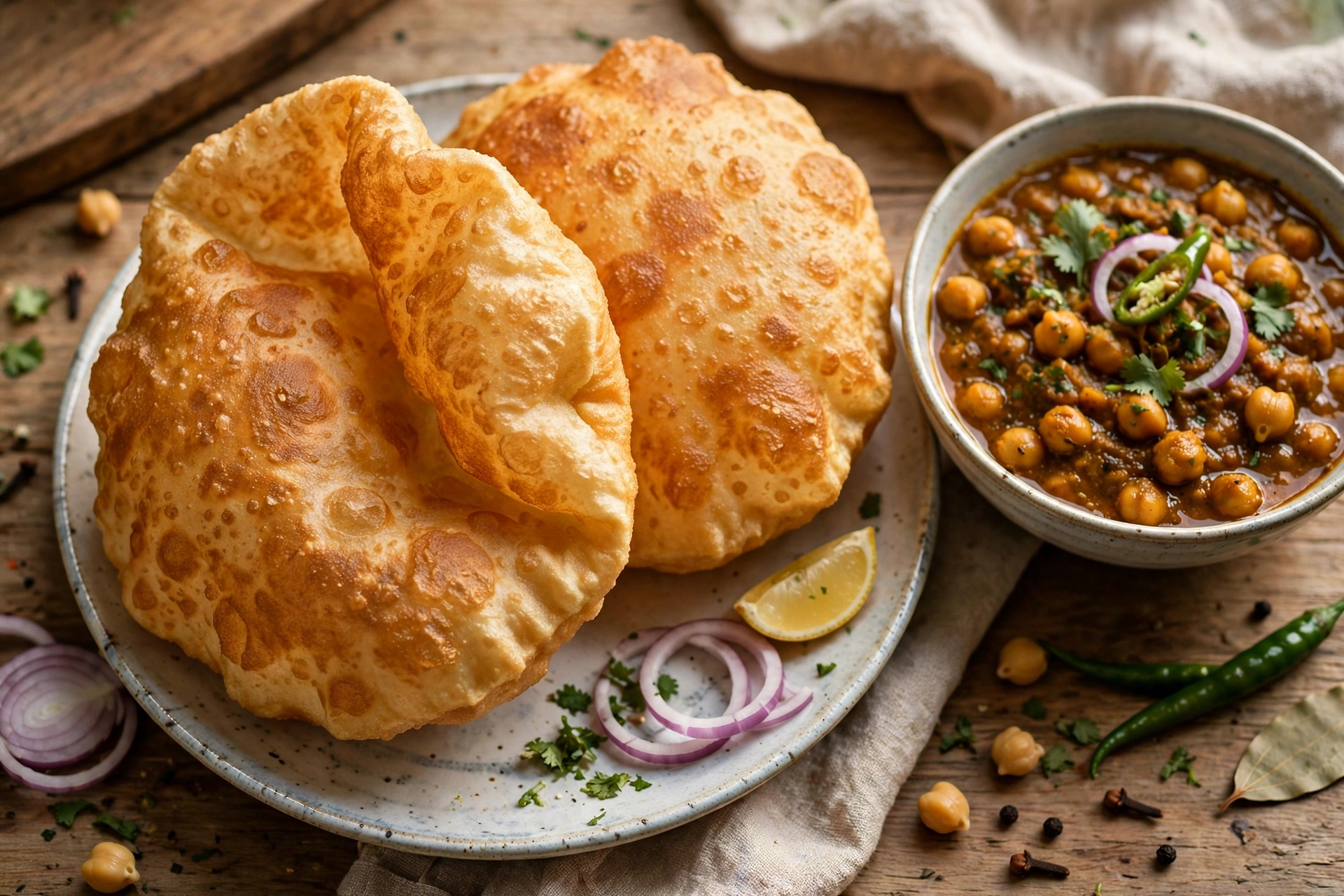
There’s a particular sound a perfect bhatura makes when it hits hot oil — a soft whoomph as it balloons into a golden pillow. The first time I got that sound in my own kitchen, after years of flat, sad, cracker-like attempts, I actually called my mother to tell her. If you’ve only ever had bhature at restaurants, this bhatura recipe will show you how achievable that puffy, chewy, slightly tangy bread is at home.
Bhatura is the inseparable partner of chole — together, chole bhature is one of North India’s most beloved street foods, sold from carts in Delhi with the bhature fried to order and served blisteringly hot. The dough is enriched with yogurt, which gives it a subtle tang and keeps it soft, and leavened so it puffs dramatically in hot oil. Unlike naan, there’s no tandoor involved — just a kadhai, hot oil, and a little courage.
My early bhature failed for one consistent reason: I treated the dough like roti dough. I’d knead it stiff, roll it thin, and wonder why it fried up like a papad. The breakthrough came when a neighbor’s auntie watched me and said, simply, “dough should be soft like your earlobe.” Weird image, unforgettable lesson. Soft, well-rested dough plus properly hot oil is the entire secret.
This bhatura recipe makes 8 large bhature — enough for 4 hungry people alongside a pot of chole. The dough needs at least 2 hours of rest (4 is better), so plan accordingly. Let’s make some noise in that kadhai.
Why You’ll Love This Bhatura Recipe
- Guaranteed puff — the soft-dough method and oil-temperature cues in this recipe make flat bhature nearly impossible.
- Soft for hours — yogurt in the dough keeps them pillowy long after frying, not just for the first five minutes.
- No yeast needed — baking soda plus yogurt does the leavening, so there’s no proofing anxiety.
- Just 6 pantry ingredients — maida, yogurt, and basics you already have.
- Freezer friendly — freeze the rolled discs between parchment and fry fresh whenever the craving hits.
- The real chole companion — once you taste homemade bhature, takeout chole bhature will never satisfy you again.
Ingredients
- All-purpose flour (maida) — 3 cups (375 g), plus extra for dusting
- Fine semolina (sooji) — 2 tablespoons (adds a lovely slight crispness)
- Plain yogurt — ¾ cup (180 g), at room temperature, whisked smooth
- Baking soda — ½ teaspoon
- Baking powder — 1 teaspoon
- Sugar — 1 tablespoon (feeds the ferment and aids browning)
- Salt — 1 teaspoon
- Oil — 2 tablespoons for the dough, plus plenty for deep frying (about 4 cups / 1 liter)
- Warm water — ¼ to ½ cup (60 to 120 ml), as needed
- Warm milk — 2 tablespoons (optional, for extra softness)
Instructions
- Mix the dry ingredients. In a large wide bowl, whisk together the maida, sooji, baking soda, baking powder, sugar, and salt. Whisking (rather than just stirring) distributes the leaveners evenly, which matters — a pocket of baking soda will leave a soapy taste in one unfortunate bhatura. Make a well in the center.
- Bring the dough together. Pour the yogurt, 2 tablespoons of oil, and the warm milk (if using) into the well. Mix with your hand in slow circles, gradually pulling in flour from the sides. Add warm water a splash at a time until you have a shaggy mass. The dough should feel noticeably softer and tackier than roti dough — this is correct and important. If it feels firm, add another tablespoon of water.
- Knead until smooth and soft. Turn the dough onto a lightly floured surface and knead for 8 to 10 minutes, pushing with the heel of your hand, folding, and turning. You’re developing just enough gluten for stretch without toughness. The finished dough should be smooth, pliable, and soft — the famous “earlobe” texture. It will still be slightly tacky; resist the urge to add lots of flour, which is what makes bhature dense.
- Rest the dough (the flavor step). Coat the dough ball lightly with oil, place it back in the bowl, cover with a damp cloth or cling film, and leave in a warm spot for at least 2 hours — 4 hours is ideal. During this rest, the yogurt’s acidity works on the flour, developing that subtle tang and relaxing the gluten so the bhature roll out easily and puff well. In winter, rest it inside the (turned-off) oven with the light on.
- Divide and shape. Punch down the risen dough gently and divide into 8 equal portions. Roll each into a smooth ball, tucking the edges underneath. Keep the balls covered with a damp cloth so they don’t dry out — dried dough cracks when rolled and won’t puff.
- Roll the bhature. On a lightly floured surface, roll one ball into an oval or round about 7 to 8 inches across and roughly ⅛-inch thick. Roll from the center outward, rotating as you go, for even thickness. Too thick and the center stays doughy; too thin and it crisps like a papad instead of puffing. Stack rolled bhature between sheets of parchment if you’re doing them all before frying.
- Heat the oil to the right temperature. Pour oil into a deep kadhai to about 2½ inches deep and heat over medium-high. The oil is ready when a tiny piece of dough dropped in sizzles immediately and rises to the surface within 2 to 3 seconds — that’s roughly 175–180°C (350°F). Too cool and the bhatura absorbs oil and stays flat; too hot and it browns before puffing. Keep a thermometer handy the first few times until you learn the look.
- Fry — and listen for the whoomph. Gently slide one bhatura into the hot oil. Within seconds it should start puffing — lightly press the center with the back of a slotted spoon to encourage it, and spoon a little hot oil over the top. Once fully puffed and pale gold underneath (about 30 seconds), flip and fry the other side for 20 to 30 seconds until evenly golden. Lift out, let the oil drip off for a few seconds, and drain on a wire rack (not paper towels, which trap steam and soften the crisp surface). Fry the rest, adjusting the heat as needed to keep the temperature steady. Serve immediately.
Pro Tips
- Room-temperature yogurt matters. Cold yogurt straight from the fridge slows the ferment and makes the dough harder to knead. Set it out 30 minutes before you start.
- Don’t over-flour when rolling. Excess dry flour burns in the hot oil, leaving bitter black specks on your bhature. Dust lightly and shake off the extra before frying.
- Oil temperature is everything. If a bhatura doesn’t puff within 10 seconds, your oil is too cool — wait, let it heat back up, and try again. Between batches the temperature drops, so give it 30 seconds to recover.
- Roll evenly or else. Thin spots puff and thick spots don’t, giving you a lopsided balloon. Take the extra 20 seconds to roll uniformly.
- Keep them warm properly. If serving a crowd, hold fried bhature in a 100°C (210°F) oven on a wire rack set over a tray — never stacked in a closed container, where steam makes them soggy.
- Freeze uncooked discs. Roll, layer between parchment, seal in a freezer bag, and freeze up to a month. Fry straight from frozen, adding about 15 extra seconds.
- Repurpose leftovers. Day-old bhature make an excellent base for a quick pizza or cut into strips and baked into crunchy salad croutons.
Serving Suggestions
Bhatura exists for chole — a dark, tangy chickpea curry is its soulmate, and the two together need little else. Add sliced onions with lemon wedges, a green chili or two, and maybe a small bowl of mango pickle on the side. For drinks, a tall glass of sweet lassi is traditional. If you’re making a full spread, start with the chole bhature as the main event and keep everything else simple.
FAQs
Why didn’t my bhatura puff up?
The three usual culprits: dough rolled too thin or unevenly, oil not hot enough, or dough that was kneaded too stiff. Check all three — but 90% of the time, it’s the oil temperature. Do the sizzle test before every single bhatura, not just the first.
Can I make the dough the night before?
Yes, and it’s actually ideal. After kneading, refrigerate the dough overnight in an oiled, covered bowl. In the morning, let it come to room temperature for about an hour before dividing and rolling. The long cold ferment gives an even better flavor.
Is there a whole wheat version?
You can replace up to half the maida with whole wheat flour (atta), but the bhature will be denser and less puffy — the gluten in maida is what gives that dramatic balloon. For your first attempt, stick with all maida.
How do I keep bhature soft after frying?
The yogurt in this recipe does most of the work. Beyond that: don’t over-fry (pale gold, not deep brown), drain on a rack instead of paper, and serve within 20 minutes. Reheating in a hot dry skillet for 20 seconds per side revives them well.
That’s the whole method — soft dough, patient rest, hot oil, and that magical puff. Pair these with a good chole, and you’ve got a meal that’ll make your kitchen smell like a Delhi street cart in the best possible way.