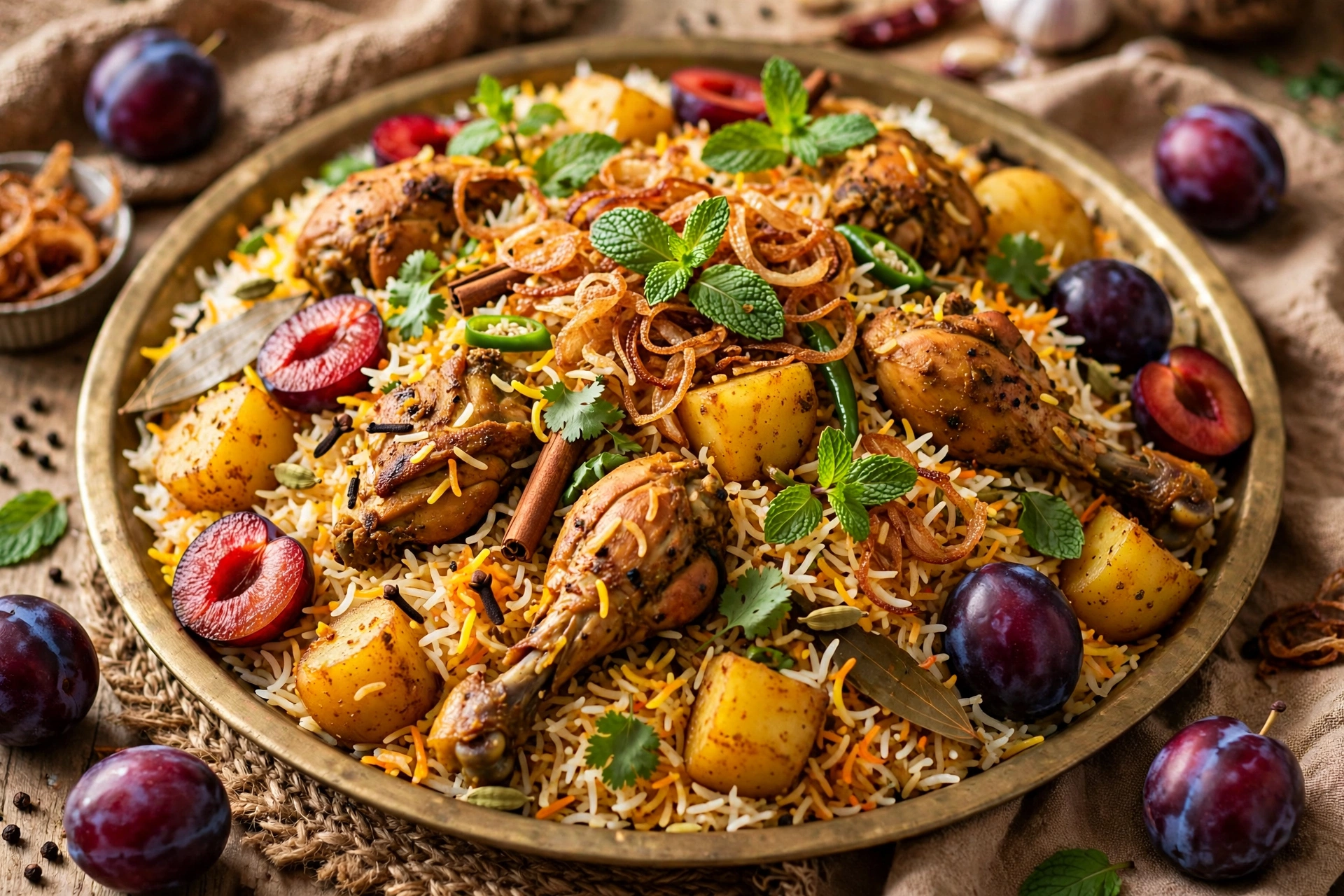
The first time I tasted a real sindhi biryani recipe done right, it wasn’t at a restaurant. It was at my friend’s house in Karachi, where his mother served it straight from a massive deg, and I remember thinking — this is nothing like the biryani I grew up eating. It was tangier, spicier, and studded with soft golden potatoes that had soaked up all that masala. I went home and spent the next three weekends trying to recreate it, and this sindhi biryani recipe is the result of all that trial and error.
What sets Sindhi biryani apart is its bold, unapologetic flavor. The yogurt-based masala brings a distinctive tang, green chilies go in whole, and red chili powder goes in generously. Aloo bukhara melt into the gravy with sweet-sour surprise — and of course the potatoes, without which Sindhi homes barely consider it biryani.
My early mistake was treating potatoes as an afterthought — they’d come out rock-hard or dissolved. The fix: cut even quarters and get them 80% tender in the masala before layering. And parboil rice to exactly 70%; the dum finishes it, because mushy biryani is the one unforgivable sin.
This recipe makes a generous deg-sized batch that serves 6 to 8 people. It takes some time, but almost all of it is hands-off simmering. Follow the steps, trust the process, and you’ll have a biryani that tastes like it came from a Karachi kitchen.
Why You’ll Love This Sindhi Biryani Recipe
- Authentic tangy-spicy flavor — yogurt-based masala with aloo bukhara gives it that signature Sindhi punch you can’t get from a box mix.
- Perfect potatoes every time — my method guarantees soft, masala-soaked aloo, never hard or mushy.
- Feeds a crowd — one pot serves 6 to 8, ideal for dawats and weekend family lunches.
- Make-ahead friendly — the masala actually tastes better the next day, and assembled biryani reheats beautifully on dum.
- No special equipment — a heavy-bottomed pot with a tight lid is all you need.
- Step-by-step dum guidance — even if you’ve never done dum before, you’ll nail it.
Ingredients
- Chicken — 750 g (about 1½ lbs), bone-in pieces, skin removed
- Basmati rice — 3 cups (600 g), soaked in water for 30 minutes
- Potatoes — 3 medium (about 400 g), peeled and cut into quarters
- Plain yogurt — 1 cup (240 g), whisked smooth
- Onions — 3 large, thinly sliced
- Tomatoes — 3 medium, chopped
- Ginger-garlic paste — 2 tablespoons
- Green chilies — 6 to 8, kept whole with a small slit
- Dried plums (aloo bukhara) — 8 to 10
- Fresh mint leaves — ½ cup, roughly chopped
- Fresh coriander — ½ cup, roughly chopped
- Cooking oil — ¾ cup (180 ml), plus 2 tablespoons ghee for layering
- Red chili powder — 2 tablespoons (adjust to taste)
- Turmeric powder — 1 teaspoon
- Coriander powder — 1 tablespoon
- Garam masala — 1 teaspoon
- Cumin seeds — 1 teaspoon
- Whole spices: 2 bay leaves, 4 green cardamoms, 4 cloves, 1-inch cinnamon stick, 8 black peppercorns
- Lemon juice — 2 tablespoons
- Saffron — a pinch soaked in 2 tablespoons warm milk (or ¼ teaspoon yellow food color)
- Kewra water — 1 tablespoon
- Salt — to taste (about 2½ teaspoons total, divided)
Instructions
- Marinate the chicken. In a large bowl, combine the chicken pieces with the whisked yogurt, ginger-garlic paste, red chili powder, turmeric, coriander powder, 1½ teaspoons salt, and lemon juice. Mix well so every piece is coated, cover, and refrigerate for at least 1 hour — 3 to 4 hours is even better. This marinade is the backbone of the whole dish; the yogurt tenderizes the chicken and the spices get a head start, so don’t rush this step if you can avoid it.
- Fry the onions until golden. Heat the oil in a heavy-bottomed pot or deg over medium-high heat. Add the sliced onions and fry, stirring often, until they turn a deep golden brown — this takes about 12 to 15 minutes. Don’t walk away; onions go from golden to burnt fast. Remove about two-thirds of the onions with a slotted spoon and set aside for layering. Leave the rest in the pot.
- Build the masala. To the onions remaining in the pot, add the cumin seeds and whole spices and let them sizzle for 30 seconds until fragrant. Add the marinated chicken along with all its marinade and cook on medium-high for 8 to 10 minutes, stirring, until the chicken firms up and the oil starts separating at the edges. Now add the chopped tomatoes, green chilies, and aloo bukhara. Cover and cook on medium-low for 15 minutes, until the tomatoes break down into a thick gravy.
- Cook the potatoes in the masala. Add the quartered potatoes to the pot, stir to coat them in the masala, and add ½ cup of hot water. Cover and simmer on low for 12 to 15 minutes, until the potatoes are about 80% tender — a knife should go in with slight resistance. They’ll finish cooking on dum. If the masala looks dry at any point, splash in a little more hot water, but keep it thick; watery masala makes soggy biryani.
- Parboil the rice. While the masala simmers, bring a large pot of water to a rolling boil with 1 tablespoon of salt, the bay leaves, and a few cardamoms. Drain the soaked rice and add it to the boiling water. Cook for exactly 4 to 5 minutes — the grains should be about 70% done, still firm in the center with a white core visible when you bite one. Drain immediately in a colander; don’t rinse.
- Layer the biryani. Turn the heat off under the masala pot. Spread half the parboiled rice over the masala in an even layer. Scatter over half the reserved fried onions, half the mint, half the coriander, and drizzle with half the saffron milk and a few drops of kewra water. Repeat with the remaining rice, onions, herbs, saffron milk, and kewra. Dot the top with the 2 tablespoons of ghee. The layering is what creates those beautiful distinct bands of color and flavor, so take a minute to do it neatly.
- Dum — the slow steam finish. Cover the pot with a tight-fitting lid. If your lid isn’t tight, seal the rim with a strip of dough or place a heavy weight on top — escaping steam is the enemy. Cook on high heat for 3 minutes to build steam, then reduce to the lowest possible flame and cook for 20 to 25 minutes. I like to place a flat tawa (griddle) under the pot to diffuse the heat and prevent the bottom from scorching.
- Rest and serve. Turn off the heat and let the biryani rest, lid on, for 10 minutes. This resting time lets the steam settle and the grains firm up — skip it and your rice may break when you mix. Open the lid, gently fluff and mix from the sides so the masala coats the rice without mashing the grains. Serve hot with raita and salad.
Pro Tips
- Cut potatoes evenly. Uneven pieces cook unevenly — quarters of medium potatoes are the sweet spot. Too small and they vanish; too big and they stay hard in the middle.
- Don’t skip the marinade time. Even one hour makes a noticeable difference in how deeply the spices penetrate the chicken.
- Taste the masala before layering. It should taste slightly saltier and spicier than you’d like, because the plain rice will mellow it out.
- Use a heavy pot. Thin pots create hot spots that burn the bottom layer during dum. A heavy deg or Dutch oven distributes heat evenly.
- Resist peeking during dum. Every time you lift the lid, precious steam escapes and the rice stops cooking evenly. Trust the timer.
- Leftover trick: Sprinkle a tablespoon of water over leftover biryani before reheating on low dum — it steams back to life beautifully.
Serving Suggestions
Serve with cooling cucumber or mint raita, a simple kachumber salad, and extra lemon wedges and green chilies so everyone can adjust tang and heat to taste.
FAQs
Can I make Sindhi biryani with beef or mutton instead of chicken?
Absolutely — mutton Sindhi biryani is a beloved variation. Just brown the mutton well and give it a longer simmer (35 to 40 minutes) before adding the potatoes, since it takes longer to tenderize than chicken. Everything else in the recipe stays the same.
Why are my potatoes still hard after dum?
This usually means the potato pieces were too large or they went into the masala too late. Cut them into even quarters and make sure they’re about 80% cooked before you start layering — the dum only finishes them, it won’t cook raw potatoes through.
Can I reduce the spiciness?
Yes. Halve the red chili powder and use only 3 to 4 green chilies. The dish will still have its characteristic tang from the yogurt and aloo bukhara, just with gentler heat. I’d keep the other spices as they are for full flavor.
How do I store and reheat leftover biryani?
Refrigerate in an airtight container for up to 3 days. To reheat, sprinkle a tablespoon of water over the rice, cover tightly, and warm on low heat for 10 to 12 minutes. Avoid the microwave if you can — it dries out the rice and toughens the chicken.
There you have it — proper Karachi-style Sindhi biryani. Once you make it this way, boxed masala packets will never tempt you again.