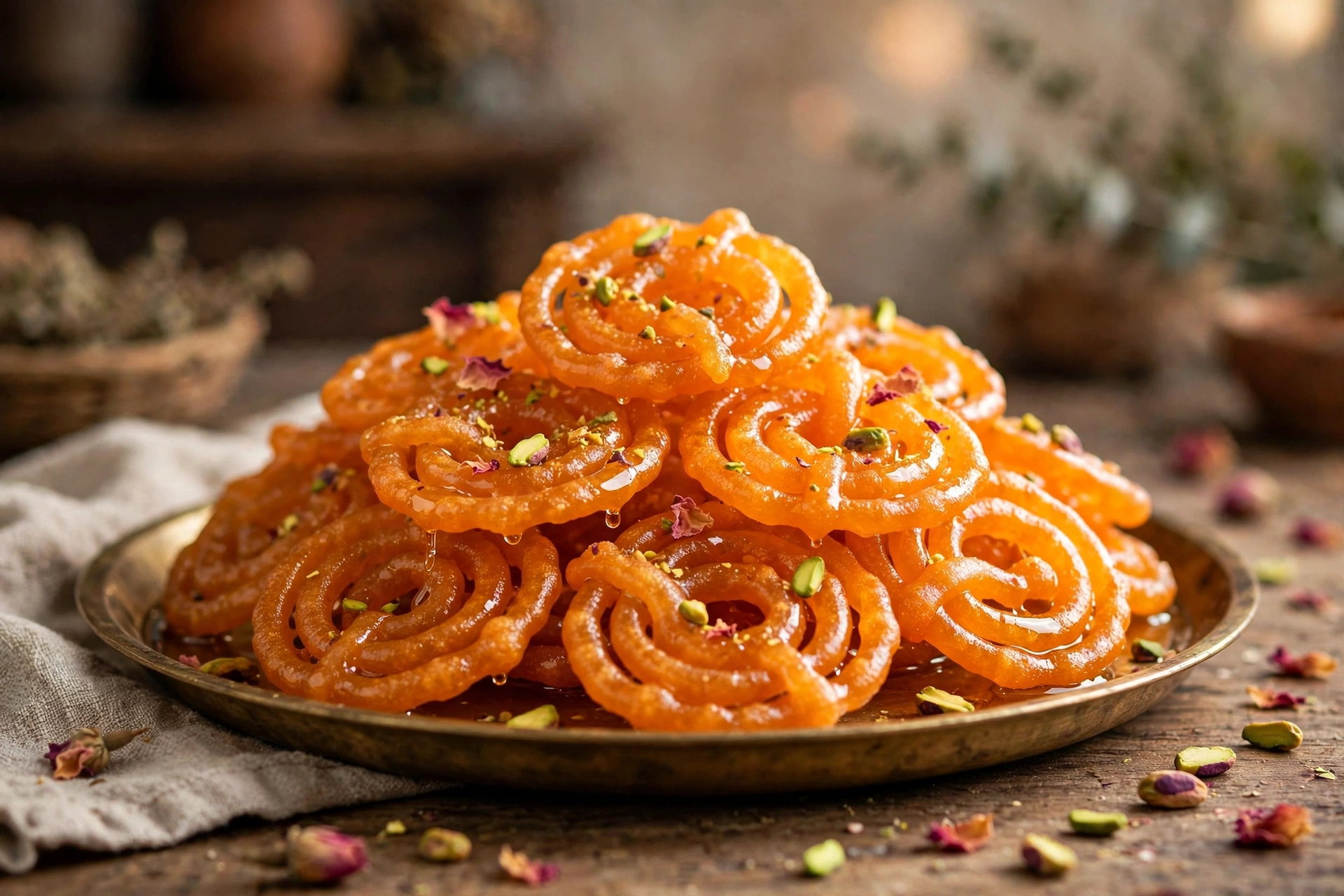
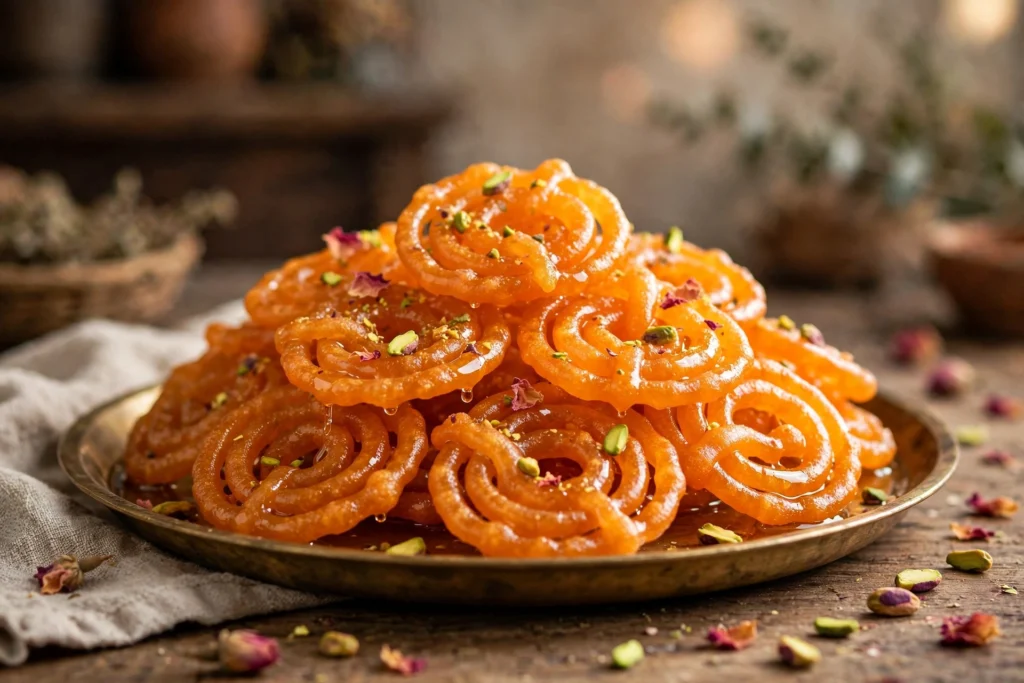
Jalebi Recipe – Crispy Golden Spirals
Somewhere in every Pakistani and Indian neighborhood, there is a halwai whose karahi starts sizzling before the sun is fully up. You smell it before you see it — hot ghee, caramelized sugar, an aroma that pulls you in. Then the coils: golden batter hissing in oil, lifted out dripping, plunged straight into saffron syrup. That first bite — shatteringly crisp, syrup flooding your mouth — is pure Eid morning, pure shaadi wali khushi.
Jalebi has a reputation as a “halwai-only” sweet, too technical for home kitchens. Honestly? It is not. Once you understand batter thickness, oil temperature, and syrup consistency, you can make jalebi that rivals the mithai shop. This is the instant version (no overnight fermentation) — real measurements, honest steps, every trick for staying crisp. Chai ready kar lo — jalebi is coming.
Why You’ll Love This Jalebi
- Genuinely crispy – batter and syrup ratios tuned so the spirals stay crisp for hours, not minutes.
- No overnight fermenting – a quick yogurt-and-baking-powder batter gets you halwai-style jalebi in under an hour.
- Saffron-cardamom syrup – fragrant, glossy, and balanced (not tooth-achingly sweet).
- Simple tools – a ketchup squeeze bottle or zip-lock bag works; no special cloth needed.
- Made for pairing – serve hot with rabri or doodh.
Ingredients
Makes about 20–22 medium jalebis — enough for 6–8 people as a dessert. Mise en place matters here: once the batter goes into the hot oil, everything moves fast.
For the Batter
- All-purpose flour (maida) – 1 cup (125 g)
- Cornstarch (cornflour) – 2 tbsp (16 g)
- Plain yogurt (dahi), at room temperature – ¼ cup (60 g)
- Baking powder – ½ tsp
- Turmeric powder (haldi) – ¼ tsp, or a pinch of orange/yellow food color (zarda rang)
- Ghee or neutral oil – 1 tsp
- Warm water – about ½ cup (120 ml), added gradually
For the Sugar Syrup (Chashni)
- Sugar – 1½ cups (300 g)
- Water – 1 cup (240 ml)
- Green cardamom pods (elaichi), lightly crushed – 4–5
- Saffron strands (kesar) – a pinch (8–10 strands)
- Rose water (araq-e-gulab) – 1 tbsp
- Lemon juice – 1 tsp (stops the syrup from crystallizing)
For Frying & Finishing
- Ghee or neutral oil – about 3 cups (750 ml), for deep frying (ghee tastes best; half and half works too)
- Pistachios (pista), chopped – 1 tbsp, for garnish
Step-by-Step Instructions
Step 1: Make the Syrup First (Chashni)
Start with the syrup, because hot jalebi must go into warm syrup. Combine sugar, water, crushed cardamom, and saffron in a wide pan; boil 5–6 minutes over medium heat until one-thread consistency (a drop between thumb and finger stretches into a thin thread, about 105°C). Stir in rose water and lemon juice, then remove from heat. Keep the pan near the stove so the syrup stays warm — not hot, not cold.
Step 2: Mix the Batter
Whisk flour, cornstarch, baking powder, and turmeric (or food color) in a large bowl until evenly colored. Add yogurt and the 1 tsp ghee, then pour in warm water gradually, whisking constantly. Aim for a thick, smooth, ribbon-like batter — slightly thicker than pancake batter — that flows in a steady stream off the whisk. Too thick turns doughy inside; too thin will not hold its coil. When in doubt, err slightly thick.
Step 3: Rest the Batter (20–30 Minutes)
Cover and rest at room temperature for 20–30 minutes. This hydrates the flour and activates the baking powder and yogurt — the secret to an airy, crisp texture. Whisk again before frying; loosen with a tablespoon of warm water if it thickened.
Step 4: Fill Your Piping Bottle
Transfer the batter to a clean ketchup squeeze bottle with a narrow nozzle (easiest option), a piping bag with a small round tip, or a sturdy zip-lock bag with a tiny corner snipped off. The squeeze bottle gives the most control over the spiral.
Step 5: Heat the Oil
Pour ghee or oil into a wide, heavy karahi to a depth of at least 2 inches; heat over medium flame to 160–170°C. A drop of batter should sizzle and rise steadily, not violently. Too hot browns the outside before the inside cooks; too cool and the jalebi drinks oil and turns soggy. A wide shallow pan beats a deep narrow one here.
Step 6: Pipe and Fry the Spirals
Hold the bottle 2 inches above the oil and pipe continuous 2–3 inch coils — center outward, then connecting the end — in one smooth motion. Fry 4–5 spirals per batch for 2–3 minutes, flipping once, until deep golden-orange and the sizzling has calmed (that quieter sizzle means the moisture cooked out — your crispness cue). Lift out, drain 5–10 seconds, and move straight to the syrup.
Step 7: The Syrup Soak (30–60 Seconds)
Slide the hot jalebi into the warm syrup. Soak 30–60 seconds per side — long enough to drink in the syrup, short enough to stay crisp. Longer than that and you are making candy, not jalebi. Lift out, let excess drip back for a few seconds, and plate. Stir the syrup gently between batches to keep the temperature even.
Step 8: Garnish and Serve Immediately
Sprinkle chopped pistachios over the hot jalebi while the syrup is still tacky. Serve within 15–20 minutes — jalebi is at its best straight from the syrup. Pair with chilled rabri or hot doodh. Mehmaan ho ya ghar wale, koi mana nahi karega.
Pro Tips for Perfect Jalebi
- Batter consistency is 80% of the game. Thick ribbon, steady stream. If the first spiral spreads into a blob, whisk in a tablespoon of flour; if the batter refuses to pipe, whisk in warm water a teaspoon at a time.
- The syrup must be one-thread, and warm. Thin syrup soaks in and goes soggy; overcooked syrup crystallizes. And hot syrup + hot jalebi = mush. Warm syrup, hot jalebi — that is the formula.
- Listen to the oil. A violent sizzle means too hot; a lazy sizzle means too cool. The sizzle should calm down as the jalebi crisps — that is your doneness cue.
- Pipe with confidence. Hesitation makes broken, uneven coils — one smooth continuous spiral per jalebi. Your third batch will look far better than your first.
- Never crowd the karahi. Overcrowding drops the oil temperature instantly and gives you oily, limp jalebi. Small batches, steady heat.
Variations
Jalebi with Rabri (the Classic Pairing): The destiny of jalebi. Serve the hot spirals over a pool of chilled rabri — slow-simmered thickened milk with cardamom and saffron. Shaadi wala combo, ghar par.
Kesar Jalebi: Double the saffron in the syrup and add ½ tsp kewra water alongside the rose water. Deeper color, richer perfume — the premium Eid/Diwali version.
Whole Wheat (Atta) Jalebi: Replace half the maida with fine whole wheat flour. The spirals come out slightly denser and nuttier, with a lovely rustic chew. Add an extra teaspoon of water since atta drinks more liquid.
Traditional Fermented Jalebi: The old-school method — skip the baking powder, use 2 tbsp yogurt instead of ¼ cup, and ferment in a warm spot for 10–12 hours overnight. Subtle tang, even lacier crunch. Frying and syrup steps stay the same.
FAQs
Why did my jalebi turn soft instead of crispy?
Usually one of three things: the oil was too cool (jalebi absorbed oil instead of crisping), the syrup was too thin or too hot (it soaked through instead of coating), or the jalebi was under-fried (pulled out before the sizzle calmed). Fix the temperature, fry until the bubbling subsides, and soak briefly.
Can I make jalebi without a piping bag?
Yes. A clean ketchup squeeze bottle is actually the easiest tool. A zip-lock bag with a small corner cut works too — double-bag it so it does not burst.
How do I get that bright orange color?
A pinch of turmeric in the batter gives a warm golden tone. For the vivid mithai-shop orange, a tiny pinch of orange food color (zarda rang) is what the shops use — safe in these small quantities. The rest of the color develops in the hot oil; pale jalebi usually came out too early.
How long does homemade jalebi stay fresh?
Peak quality is 2–3 hours at room temperature, then it slowly softens. Revive day-old jalebi in a 180°C oven for 5 minutes — it crisps right back up. Do not refrigerate; the cold makes the syrup weep.
Conclusion
Jalebi looks like magic and tastes like celebration, but strip away the mystique and it is just batter, oil, and syrup in the right balance. The first batch might be a little wonky; by the third, you will be piping spirals like you have done it for years, and the whole house will smell like a mithai shop.
So heat the karahi and warm the syrup this weekend. Serve the jalebi hot, watch that first crisp bite go quiet around the table — and bas, samajh jana, your jalebi worked.