Sugar-Free Gulab Jamun Recipe – Diabetic-Friendly Soft Mithai at Home
Gulab jamun is the undisputed king of desi mithai — soft, spongy, golden dumplings swimming in fragrant rose-cardamom syrup. It shows up at every shaadi, every Eid, every winter dawat. But if you are watching your sugar — diabetic, pre-diabetic, or just cutting back — the mithai table usually means sitting out while everyone else digs in.
This sugar-free gulab jamun recipe changes that. Same melt-in-mouth texture, same juicy syrup, same gulab-elaichi fragrance — lekin cheeni zero. We use a heat-stable erythritol + monk fruit blend for the syrup, a dough rest that keeps jamuns pillowy-soft instead of dense, and a slow-frying method that turns them deep golden without bitterness.
Why You’ll Love This Sugar-Free Gulab Jamun
- Zero refined sugar — erythritol-monk fruit syrup tastes like real cheeni ka sheera, without the blood-sugar spike of regular gulab jamun
- Pillowy, not dense — the dough rest + low-heat frying method gives jamuns that spring back when pressed
- No weird aftertaste — the right sweetener ratio plus rose, cardamom and a touch of saffron mask any cooling note
- Dawat-worthy — make a big batch ahead; jamuns soak beautifully and taste even better the next day
- Honest nutrition — real numbers below, doctor/dietitian caveat included; no miracle promises
Ingredients
Makes about 20 jamuns (5–6 servings, 3–4 jamuns per person).
For the jamun dough
- Milk powder (full-cream, unsweetened) — 1 cup (120g)
- All-purpose flour (maida) — 1/4 cup (30g)
- Baking soda — 1/2 teaspoon (level, not heaped)
- Desi ghee — 2 tablespoons, melted
- Full-fat milk — 1/4 cup (60ml), lukewarm, plus 1–2 teaspoons extra if needed
- Plain yogurt (dahi) — 1 tablespoon
- Fine semolina (sooji, optional but recommended) — 1 teaspoon
For the sugar-free syrup
- Erythritol + monk fruit blend (1:1 sugar replacement, heat-stable) — 1 cup (200g)
- Water — 1 and 1/2 cups (360ml)
- Green cardamom pods — 4, lightly crushed
- Rose water (kewra/araq-e-gulab) — 1 teaspoon
- Saffron strands (kesar) — a generous pinch, soaked in 1 tablespoon warm water
- Lemon juice — 1/2 teaspoon (prevents crystallization)
For frying and garnish
- Neutral oil or ghee — 2 cups, for deep frying (jamuns must float freely)
- Crushed pistachios — 1 tablespoon
- Dried rose petals — 1 teaspoon (optional)
Ingredient Notes
Khoya vs milk powder. Traditional halwai gulab jamun uses khoya, but khoya varies wildly in moisture and is hard to get right at home. Milk powder gives consistent, crack-free jamuns every time — and most brands are unsweetened, keeping the dough sugar-free friendly.
Which sweetener? Use a 1:1 erythritol–monk fruit blend (the kind marketed as a sugar replacement for baking). Pure erythritol recrystallizes as the syrup cools and leaves a cooling aftertaste; the monk fruit rounds it out. Avoid aspartame or sucralose-only sweeteners for the syrup — they break down or taste off at boiling temperatures.
Step-by-Step Instructions
Step 1: Mix the dough (10 minutes + 20 minutes rest)
Rub in the melted ghee with your fingertips until it looks like damp sand. Add the yogurt and the lukewarm milk, and bring it together into a soft, slightly sticky dough — mix with a light hand, no kneading. Kneading develops gluten and makes jamuns dense.
Cover with a damp cloth and rest for 20 minutes. If it feels dry after resting, wet your palms and knead gently for 30 seconds — the dough should be smooth and pliable, like soft atta.
Step 2: Make the sugar-free syrup (10 minutes)
While the dough rests, combine the sweetener blend, water and crushed cardamom in a wide pan. Bring to a boil, stirring until dissolved, then simmer 5–6 minutes to a thin, one-thread consistency — a drop between thumb and forefinger forms a single thin thread. Stir in the lemon juice, saffron water and rose water, then take it off the heat. Keep the syrup warm, not boiling — cold syrup won’t soak into the jamuns.
Step 3: Shape the jamuns (10 minutes)
Grease your palms with a drop of ghee. Pinch off walnut-sized portions (about 20g each) and roll into perfectly smooth balls with no cracks — cracks open up in hot oil. Keep shaped jamuns covered with the damp cloth so they don’t dry out.
Step 4: Fry low and slow (20–25 minutes)
Heat the oil on low-medium heat — test with a tiny piece of dough; it should sink, then rise slowly with gentle bubbles. If it browns instantly, the oil is too hot.
Slide in 6–7 jamuns at a time. Do not stir for the first 2 minutes. Then, using a slotted spoon, keep them gently rolling so they brown evenly — 7–8 minutes per batch. Drain on a wire rack for 1 minute.
Step 5: Soak in the warm syrup (minimum 2 hours)
Drop the hot jamuns straight into the warm syrup — they should be submerged. Cover and soak for at least 2 hours, ideally 4–6 hours or overnight in the fridge. The jamuns will swell to nearly double their size.
Step 6: Serve warm
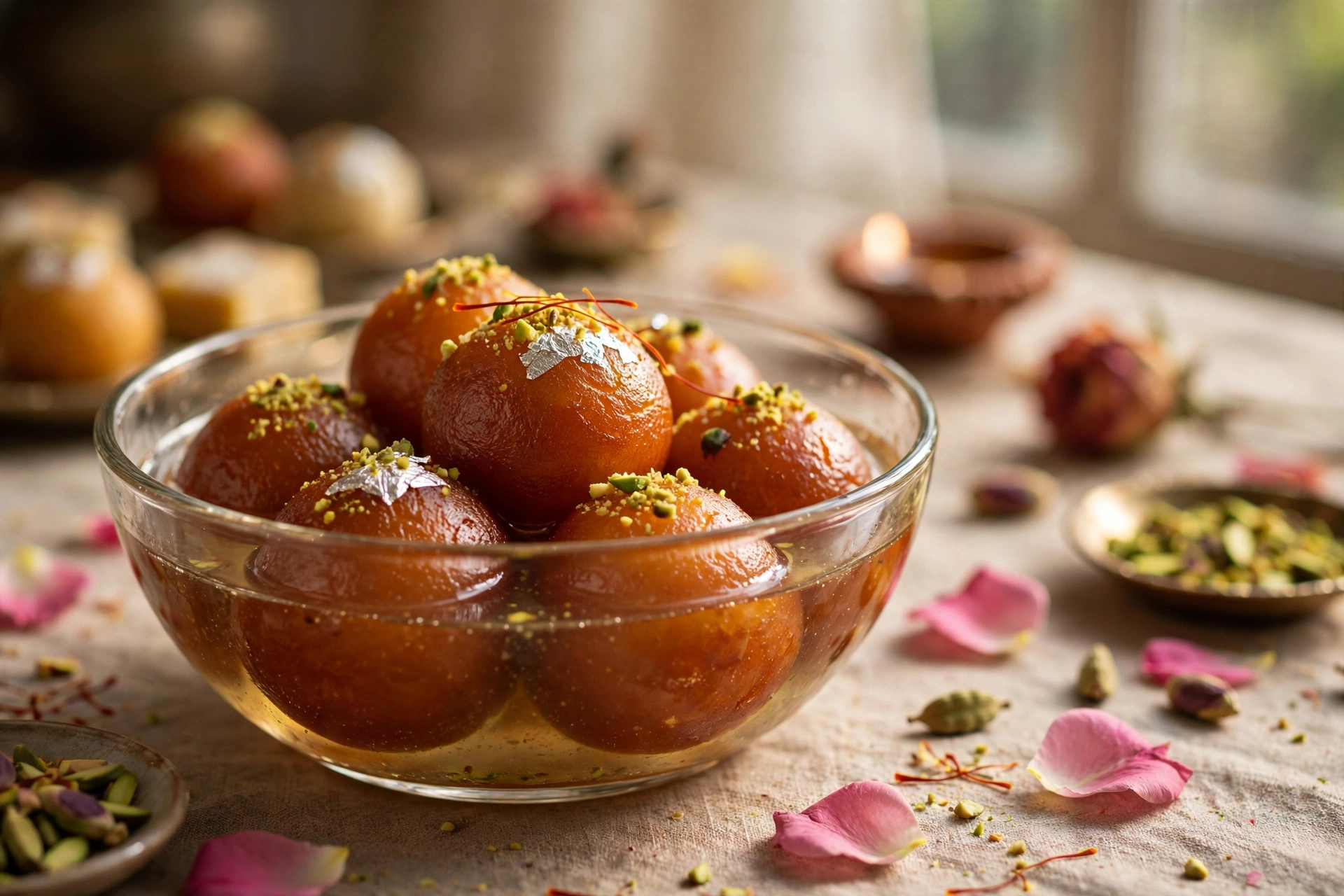
Warm the jamuns gently in their syrup before serving — 30 seconds in the microwave or a few minutes on low heat. Garnish with crushed pistachios and rose petals, and serve 3–4 jamuns per person with a spoonful of warm syrup.
Pro Tips for Perfect Sugar-Free Gulab Jamun
- Crack-free rolling is everything. If a ball shows even a hairline crack, re-roll it. Cracks become craters in hot oil.
- Oil temperature decides the texture. Too hot = dark outside, doughy inside. That dough-piece test in Step 4 is your thermometer.
- Warm syrup, warm jamuns. Hot jamuns into warm syrup gives maximum absorption; cold syrup gives a glazed-but-dry center.
- Don’t overcrowd the kadhai. Jamuns expand as they fry — 6–7 per batch, or the oil temperature crashes.
- Next-day magic. Like our sugar-free kheer, these taste better after a full overnight soak. Plan one day ahead for dawats.
Variations
Kala Jamun (sugar-free): Fry the jamuns 2–3 minutes longer until they turn a deep, almost-black caramel color, then soak in the same syrup. The slight bitterness of the dark crust against the sweet syrup is a classic halwai contrast.
Paneer Gulab Jamun: Replace half the milk powder with finely grated fresh paneer (squeezed dry). Slightly richer, slightly tangier — reduce the yogurt to 2 teaspoons since paneer adds moisture.
Baked version (lighter): Bake shaped jamuns at 180°C for 12–14 minutes, brushing with ghee halfway, then soak in warm syrup. They won’t be as evenly golden as fried, but they cut the oil dramatically.
Storage and Reheating
Refrigerate soaked jamuns in their syrup in an airtight container for up to 5 days — the flavor deepens beautifully. Reheat gently on low heat for 4–5 minutes; never a rolling boil (boiling toughens them). Freeze un-soaked fried jamuns for up to 2 months; thaw, then soak in fresh warm syrup for 4 hours.
Honest Nutrition (Per 3-Jamun Serving)
Approximate values with the erythritol-monk fruit blend and 2 cups frying oil (most oil stays in the kadhai):
- Calories: ~210 kcal
- Protein: ~5g
- Fat: ~11g
- Carbohydrates: ~24g total, of which ~18g is erythritol (not metabolized like sugar) → roughly 6g net digestible carbs
A regular gulab jamun carries 25–30g of actual sugar per 3 pieces; this version carries essentially none. That said: these are general nutrition estimates, not medical advice. “Sugar-free” does not mean “eat unlimited.” If you have diabetes or any medical condition, check with your doctor or dietitian about sweeteners and portion sizes that suit you.
FAQs
Can diabetics eat sugar-free gulab jamun?
That is exactly who this recipe is for — no refined sugar anywhere, and the syrup sweetener does not spike blood sugar the way cheeni does. But portion control still matters (they are still fried milk dumplings), and your doctor or dietitian should have the final word.
Why did my jamuns turn hard or dense?
Three usual suspects: over-kneaded dough (develops gluten), oil too hot (seals the outside before the inside puffs), or too much baking soda. Soft dough, low-medium oil, and a level half-teaspoon fix all three.
Can I use stevia instead of erythritol?
Pure stevia in hot syrup tends to taste bitter at the quantities needed for mithai. The erythritol-monk fruit blend is much closer to sugar’s clean taste. If you only have stevia, test a small batch first — its aftertaste gets stronger in bulk.
Can I make these ahead for a dawat?
Absolutely — in fact you should. Fry the jamuns a day ahead, store them un-soaked in an airtight container, then soak in fresh warm syrup 4–6 hours before serving. Pair them with sugar-free besan ladoo and sugar-free gajar ka halwa for a full diabetic-friendly mithai platter.
Conclusion
Sugar-free gulab jamun proves that “meetha without cheeni” is not a compromise — it is a technique. Get the dough soft, the oil patient, and the syrup fragrant, and nobody at the dastarkhwan will guess the difference.