Kadhi Pakora Recipe – Creamy Pakistani Yogurt Curry with Crispy Pakoras
The first time it rains properly after a long, hot summer, something shifts in a Pakistani kitchen. The air smells of wet mitti, and someone’s mother or nani is already at the stove whisking yogurt and besan together. Barish ho, aur kadhi pakora na bane? In my house, that simply does not happen.
Kadhi pakora is the definition of desi comfort food: a silky, tangy yogurt-and-gram-flour curry, simmered low and slow until thick and glossy, with crispy onion pakoras dropped in at the end. It tastes like a rainy Sunday afternoon, even on a dry Tuesday — and it is made from pantry basics.
This recipe gives you real measurements, honest timing, and every trick to keep the kadhi smooth and creamy — no splitting, no lumps. Serves 4–5, with boiled rice or zeera rice.
Why You’ll Love This Kadhi Pakora
- Pure comfort in a bowl – tangy, creamy, warming; the curry equivalent of a hug on a cold or rainy day.
- Budget-friendly pantry dish – yogurt, besan, and onions cost almost nothing, and it feeds a full family.
- Make-ahead friendly – the kadhi tastes even better the next day once the flavors settle.
- Pakoras stay the star – fried fresh and added at the end for that soft-yet-crisp contrast.
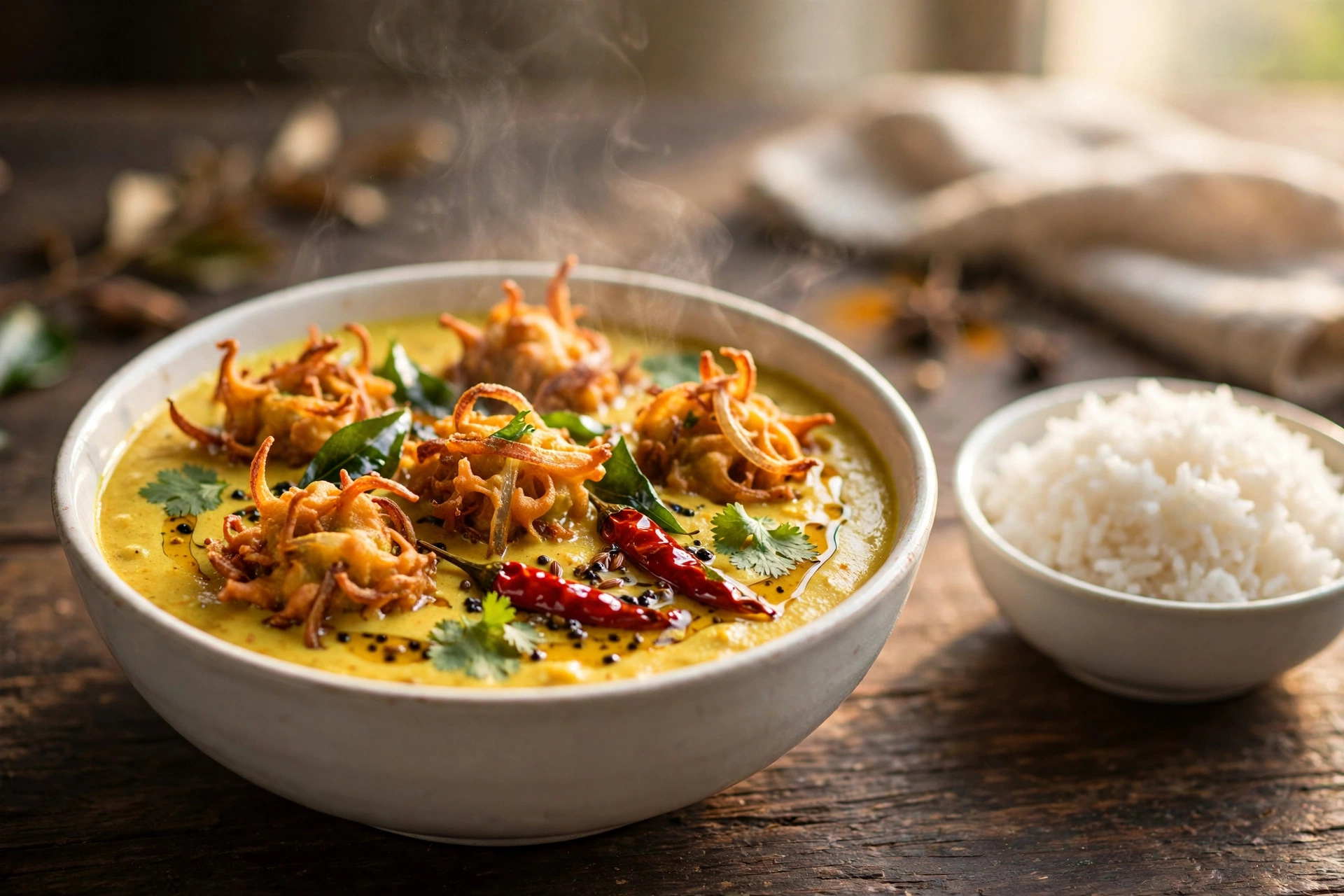
Ingredients
Serves 4–5. Use full-fat, slightly sour yogurt for the best tang — fresh, mild yogurt makes a flat kadhi.
For the Kadhi
- Full-fat plain yogurt (dahi), well whisked – 2 cups (500 g)
- Besan (gram flour), sifted – 1/2 cup (60 g)
- Water – 5 cups (1.2 litres), divided
- Turmeric powder (haldi) – 1/2 tsp
- Red chili powder – 1/2 tsp (adjust to taste)
- Salt – 1½ tsp (add after the kadhi comes to a boil — see tips)
For the Onion Pakoras
- Besan (gram flour) – 1 cup (120 g)
- Onions, thinly sliced – 2 large (about 300 g)
- Green chilies (hari mirch), finely chopped – 2
- Fresh coriander (dhania), chopped – 2 tbsp
- Ajwain (carom seeds) – 1/2 tsp
- Zeera (cumin seeds) – 1/2 tsp
- Red chili powder – 1/2 tsp
- Salt – 3/4 tsp
- Water – about 1/3 cup (80 ml), as needed
- Oil, for deep frying – about 2 cups
For the Tarka (Tempering)
- Desi ghee or oil – 2 tbsp
- Zeera – 1 tsp
- Rai (mustard seeds) – 1/2 tsp (optional, Punjabi style)
- Dried red chilies (sabut lal mirch) – 3–4
- Curry leaves (kari patta) – 8–10
- Garlic cloves, thinly sliced – 4
- Hing (asafoetida) – 1 small pinch (optional)
How to Make Kadhi Pakora – Step by Step
Step 1: Fry the Pakoras First
Start with the pakoras so they are hot and ready when the kadhi needs them. Mix the sliced onions with salt, ajwain, zeera, red chili powder, chopped green chilies, and coriander in a bowl. Let it sit for 5 minutes — the onions release water, so you need less added water.
Add the besan and toss everything together, then sprinkle in water a tablespoon at a time until you have a thick batter that just coats the onions. It should not be runny — onion slices should be visible through the batter, not swimming in it.
Heat the oil to medium-hot (about 175°C / 350°F). Drop in rough tablespoon-sized clumps of batter — pakoras should look rustic, not round. Fry in batches for 4–5 minutes, turning once, until deep golden and crisp. Drain on a wire rack or paper towel.
Step 2: Whisk the Kadhi Base (No Lumps!)
This is the make-or-break step. Put the sifted besan in a large, heavy-bottomed pot and add the yogurt a little at a time, whisking constantly until smooth. Then whisk in the turmeric and red chili powder, and finally the water, a cup at a time. The mixture should be thin and completely lump-free — strain it through a fine sieve if you see even small lumps. Besan lumps will not cook out later.
Step 3: Cook Low and Slow (30–40 Minutes)
Place the pot on medium-high heat and bring to a boil, stirring continuously — this part is non-negotiable. Stop stirring before the boil and the yogurt can split. Keep a wooden spoon moving in slow figure-eights across the bottom.
Once it reaches a rolling boil, add the salt, reduce the heat to low, and let it simmer uncovered for 30–35 minutes, stirring every few minutes. The kadhi will thicken, turn glossy, and the raw besan taste will cook away completely. It is done when it coats the back of a spoon. Remember: kadhi thickens more as it cools, so stop when it is slightly thinner than you want to serve.
Step 4: Add the Pakoras
Drop the hot, crispy pakoras into the simmering kadhi and stir. Simmer together for 8–10 minutes so the pakoras soak up the curry without falling apart. Taste and adjust salt and chili.
Step 5: Make the Tarka and Finish
Heat the ghee in a small pan until shimmering. Add the zeera and rai; when they crackle, add the dried red chilies, curry leaves (stand back — they splutter), sliced garlic, and hing. Fry 30–40 seconds until the garlic is golden, then pour the sizzling tarka over the kadhi. Stir it in and cover for 5 minutes so the aroma settles in.
Step 6: Rest and Serve
Turn off the heat and let the kadhi rest, covered, for 10 minutes. Serve hot with plain boiled rice or zeera rice — rice is the classic pairing. Garnish with a little fresh coriander if you like.
Pro Tips for Perfect Kadhi Pakora
- Salt goes in after the boil. Adding salt to the cold yogurt mixture increases the chance of splitting — season only once it is boiling.
- Full-fat yogurt only. Low-fat yogurt makes a watery kadhi that refuses to thicken and splits easily. If your yogurt is runny, hang it in a muslin cloth for 20 minutes first.
- Slightly sour yogurt = better tang. Day-old yogurt gives kadhi its signature khatta flavor. Very fresh, sweet yogurt makes a bland kadhi.
- Never walk away before the boil. Continuous stirring until the first boil is the single most important rule. After that, occasional stirring is enough.
- Fry pakoras fresh, add them hot. Cold, soggy pakoras make a sad kadhi — time it so the pakoras come out of the oil as the kadhi finishes simmering.
- Thin it, don’t panic. If the kadhi gets too thick while resting, whisk in a splash of hot water — never cold water, which can shock the curry.
Variations
- Punjabi-style kadhi: make it thicker (use 4 cups water instead of 5), add the rai and extra turmeric — this is the dhaba-style version, bold and hearty.
- Meethi (sweet-sour) kadhi: Gujarati and Rajasthani style — stir in 1–2 tbsp jaggery (gur) with the salt for that sweet-tangy balance. Skip the rai; add a pinch of cinnamon.
- Palak pakora kadhi: add a handful of chopped spinach to the pakora batter for green, iron-rich pakoras.
- Aloo pakora kadhi: swap the onions for thin potato slices in the pakora batter — a Lahori favorite.
FAQs
Why did my kadhi split or curdle?
Almost always one of three reasons: the yogurt was low-fat, you added salt before boiling, or you stopped stirring before the first boil. Use full-fat yogurt, add salt only after it boils, and keep the spoon moving until then — and a split kadhi is nearly impossible.
Can I make kadhi pakora ahead of time?
Yes — the kadhi base (without pakoras) keeps in the fridge for 3–4 days and reheats beautifully with a splash of hot water. Fry fresh pakoras when serving, or store fried pakoras at room temperature for a day and warm them in the oven before adding.
Can I freeze kadhi?
The kadhi base freezes well for up to a month in airtight containers — thaw overnight in the fridge and reheat gently, whisking. Do not freeze it with the pakoras in; they turn mushy. Add fresh pakoras after reheating.
My besan tastes raw. What went wrong?
It needed more simmering time. Kadhi must cook at least 30 minutes after boiling — that long, slow simmer is what cooks out the raw besan flavor. Rushing this step is the most common mistake.
What do you serve with kadhi pakora?
Plain steamed basmati rice is the classic — kadhi chawal is a combination people get emotional about. Zeera rice works beautifully too.
Conclusion
Kadhi pakora is proof that the humblest ingredients make the grandest food. Yogurt, besan, onions, a few spices — and out comes a curry that is tangy, creamy, and deeply comforting. Follow the two golden rules (whisk out every lump, stir until the boil) and it will come out perfect the first time.
Make it on the next rainy day, or honestly on any day that needs a little comfort. Serve it over hot rice, take that first spoonful, and you will understand why barish aur kadhi pakora belong together.